
Advertisements
Nearly 60% of Americans say they have less than three months of living expenses saved. Many never try a simple plan that could change this. A household budget is a clear, practical way to track income and spending.
It sets spending limits, prioritizes savings and paying off debt, and links daily choices to financial goals.
This guide is for U.S. households: couples, single parents, roommates, and individuals new to budgeting. It offers plain, easy-to-understand advice.
Advertisements
Step-by-step tips will help you start budgeting and save money the same week you begin.
The article helps readers set goals, track income and expenses, and sort costs into categories. It shows how to build and adjust a realistic budget.
You’ll find saving strategies, ways to cut costs, and apps to simplify budgeting. These tools help reduce overspending and build emergency savings.
They also help clarify financial priorities and improve progress toward short- and long-term goals.
Research from the Consumer Financial Protection Bureau and NerdWallet shows that budgeting improves debt management and raises savings. It also lowers financial stress.
The tone is practical and clear, offering straightforward advice without confusing jargon.
Key Takeaways
- Define a household budget as a plan that tracks income, limits spending, and prioritizes savings.
- Budgeting for beginners can start with simple steps and daily habits that yield quick wins.
- Applied money-saving tips and consistent tracking often lead to larger emergency funds and reduced debt.
- Practical financial planning advice and the right tools make budgeting sustainable for American households.
- Following this guide will help clarify priorities and improve progress toward both short- and long-term goals.
Understanding the Importance of a Household Budget
Creating a household budget brings clarity to everyday money choices. Tracking income and expenses gives families a clear view of cash flow.
This visibility helps with managing household expenses and prevents shortfalls that lead to late bills or surprise credit card balances.

Budgeting for beginners starts with small steps. A simple plan for irregular costs such as car repairs or annual insurance premiums reduces stress when bills arrive.
Agencies like the Consumer Financial Protection Bureau offer guidance on building resilience for these events.
Why Budgeting Matters
When a household tracks money, it can prioritize needs over wants. Without a plan, families risk missed savings opportunities and higher interest on debt.
Clear budgeting supports planning for life events such as relocation or childbirth.
Good budgeting improves the ability to save for retirement and build an emergency fund. These outcomes lower long-term risk and provide more future options.
Common Budgeting Myths
One myth says budgets are only for low-income households. In reality, people at every income level benefit from discipline and a spending plan.
Wealthy households use budgets to reach goals and protect assets.
Another myth claims budgeting is overly restrictive. A working budget gives freedom by aligning spending with priorities instead of reacting to whims.
Complex spreadsheets are not necessary. Simple frameworks like zero-based budgeting or the 50/30/20 rule work well for managing household expenses.
Benefits of a Well-Managed Budget
Measurable gains include reduced debt, steady growth of emergency savings, and more consistent retirement contributions. Tracking expenses can improve credit score management over time.
Psychological benefits are clear. Households report less financial anxiety and better communication about money.
Following practical household budget tips from sources like Bankrate and Investopedia links budgeting to improved outcomes and greater confidence in long-term plans.
Setting Financial Goals for Your Household
Clear goals guide how money is divided each month. They create urgency and set monthly savings targets. This helps with daily and long-term financial planning.
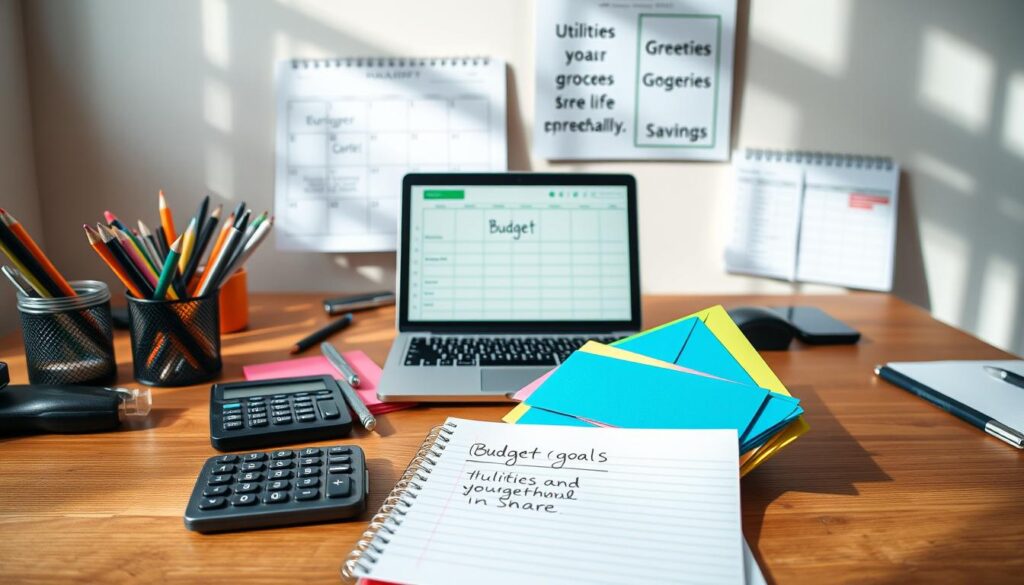
Short-term goals last 0–2 years and are easy to see. Examples include building a $500–$2,000 emergency fund or paying off small credit card debt. Saving for a family vacation or a used car down payment also counts.
These targets help beginners focus on quick wins that protect cash flow. Keeping goals clear helps budgeting make sense fast.
Long-term goals are for three years or more. Common goals include buying a home, saving for retirement, or paying off big debts. Setting real timeframes keeps goals on track and measurable.
Use a simple list to compare goal types:
- Short-term: emergency fund, small debt payoff, short savings projects.
- Long-term: home purchase, retirement, large debt reduction.
Start prioritizing with essentials. Protect your household with an emergency fund and the right insurance. Then focus on paying off high-interest debt. After these, work toward growth goals like retirement and investments. This order saves money and lowers credit costs.
Follow these steps to set priorities:
- List all goals and note who they affect.
- Estimate costs and choose deadlines.
- Decide how much to save monthly for each goal.
- Track progress and adjust savings as needed.
Use SMART criteria for each goal: make it Specific, Measurable, Achievable, Relevant, and Time-bound. This helps keep budget plans clear and families focused.
Regular talks are important. When family members review shared and personal goals, they lower conflict and build commitment. Open dialogue improves budgeting and keeps priorities clear as life changes.
Tracking Your Income and Expenses
Accurate tracking turns vague plans into practical household budget tips. A clear record of money in and out helps manage expenses. This keeps goals realistic and achievable.
The next parts show how to list income, capture spending, and choose budgeting tools that fit a household’s needs.
Creating an Income Inventory
Start by listing every income source: salaries, wages, freelance work, child support, dividends, rental income, and government benefits. Include gross amounts and note taxes withheld.
When income varies, average monthly receipts over six to twelve months. Use a conservative figure for planning. Save extra cash from high months in a buffer fund.
Plan for tax obligations. Freelancers and investors should estimate quarterly payments. Check if employer withholding covers all liability. Clear tax planning avoids surprises.
Keeping Tabs on Your Spending
Capture expenses in multiple ways. Collect receipts, download bank and credit card statements, and keep a daily spending log. Categorize each transaction right away.
Track common categories: housing, utilities, groceries, transportation, insurance, medical, education, entertainment, and debt payments. Review recurring charges and subscriptions for savings.
Run a 30–90 day tracking period to build a reliable baseline. Use this to set targets and spot seasonal swings affecting budgeting decisions.
Tools for Tracking Finances
Choose from automated apps and manual methods. Popular options include Mint, YNAB (You Need A Budget), EveryDollar, Personal Capital, Google Sheets, and Excel. Bank budgeting dashboards can help, too.
Automated syncing saves time and shows real-time balances. Manual entry builds discipline and awareness. Free tools reduce costs. Paid services may add coaching or extra features.
Personal Capital excels at investment tracking. YNAB supports envelope-style budgeting and hands-on control. Pick tools that match your household’s tech skill and financial needs.
Categorizing Your Monthly Expenses
Clear categories make budgeting easier. Readers learn to split costs into predictable and flexible groups. This step helps with household budget tips and managing expenses effectively.
Fixed expenses are steady monthly obligations. Examples include rent, mortgage payments, car loans, insurance premiums from companies like State Farm or Geico, and streaming subscriptions such as Netflix.
Variable expenses change each month. Groceries, utilities, gasoline, dining out, and entertainment fall here. Tracking bank and credit card statements for six months helps identify these items accurately.
Next, analyze your spending. Compare past statements to find patterns. Variable costs show where smart spending tips can help, and small cuts can make a big difference.
Fixed costs reveal opportunities to refinance a mortgage or negotiate insurance rates for savings.
How to quantify each category:
- Gather three to six months of statements for checking, credit cards, and bills.
- Label recurring charges as fixed and one-time or fluctuating charges as variable.
- Calculate monthly averages for variable items to make realistic forecasts.
The 50/30/20 rule offers a simple split for beginners. Allocate 50% of after-tax income to needs, 30% to wants, and 20% to savings and debt repayment.
Needs include rent, groceries, utilities, and health insurance. Wants cover dining out, streaming, and travel expenses.
This guideline is flexible. In high cost-of-living cities like San Francisco or New York, needs may exceed 50% of income.
Aggressive savers might shift to 60/20/20 or 70/20/10 to speed debt payoff or increase investments.
Use the 50/30/20 rule as a diagnostic tool. If wants go over 30%, it signals room for smart spending tips.
If savings are less than 20%, focus on cutting variable expenses or increasing income to better manage household expenses.
Creating a Realistic Budget
Building a budget that sticks starts with clear steps and realistic goals. It helps manage monthly cash flow and reduce stress. Household budget tips guide each step from counting income to adjusting after a trial.
Steps to Build Your Budget
1. Combine your net monthly income after taxes and steady deductions like Social Security and health insurance. Use take-home pay, not gross salary.
2. Track expenses to set baseline amounts for fixed and variable categories. Check banking and credit card statements carefully.
3. Allocate funds to priority goals first: emergency fund, debt repayment, and retirement. This reduces long-term risks and builds security.
4. Set realistic spending limits and include small buffers for irregular costs like vehicle registration or property taxes.
5. Follow the plan and monitor it for 30–90 days. Track spending, then adjust limits and goals as needed.
Recommended templates include free budget sheets from the Consumer Financial Protection Bureau and Mint. These resources help speed up setup and offer clear monthly layouts.
Common Budgeting Mistakes to Avoid
Underestimating variable expenses like groceries causes overspending. Include seasonal costs and one-time bills to avoid surprises.
Strict budgets can cause burnout and quit plans early. Include small rewards to stay motivated and committed.
Failing to consider irregular income can harm your budget. Use cautious estimates and update when pay or household size changes.
Relying only on cash-flow rules without savings or debt goals limits progress. Set clear targets for emergency funds and monthly debt payments.
Ignoring the emotional side of budgeting is common. Plan brief rewards and checkpoints to keep good habits and sustain the budget.
Adjusting Your Budget for Life Changes
Life often shifts suddenly. A new baby, job change, move, medical bill, or caregiving can change cash flow overnight.
Households that track expenses and follow clear budget tips recover faster. They also stay on track more easily.
Start with a quick review when changes occur. Check take-home pay, update categories, and set new priorities.
Small moves can free funds for ongoing costs without harming long-term goals.
Dealing with New Expenses
Identify which costs are one-time and which repeat. A newborn means recurring diaper and childcare expenses.
A move may raise rent but reduce commuting costs. Accurate categories help with frugal living and realistic planning.
Use this checklist to manage new recurring costs:
- Re-evaluate net income and benefits.
- Update expense categories and monthly totals.
- Reprioritize financial goals, such as emergency savings or debt payoff.
- Search for savings in groceries, subscriptions, and utilities.
Negotiate recurring bills when possible. Contact providers like AT&T, Comcast, State Farm, or Progressive to compare plans.
Re-shop insurance and internet packages to cut fixed costs. This supports managing household expenses effectively.
Adapting Budget Strategies During Emergencies
Emergencies include job loss, major medical bills, disasters, or urgent repairs. A quick plan helps protect housing and utilities.
An emergency response plan should include these steps:
- Pause discretionary spending like dining out and entertainment.
- Draw from an emergency fund if available.
- Contact creditors to request hardship programs or payment changes.
- Prioritize rent, mortgage, utilities, and essential transport.
Short-term cash preservation helps bridge gaps. Temporarily cancel streaming, plan simple meals, and use community resources when needed.
| Situation | Immediate Action | Short-Term Savings | Recovery Step |
|---|---|---|---|
| New baby | Update budget for childcare and supplies | Buy generic diapers, bulk purchases | Adjust goals; rebuild emergency fund |
| Job change | Forecast new income and benefits | Cut nonessential subscriptions | Create 3–6 month reserve |
| Move to higher rent | Compare commute and utility changes | Shop local grocery deals, use energy tips | Negotiate lease renewal or downsize |
| Major medical bill | Contact providers for payment plans | Delay nonurgent purchases | Rebuild savings with automatic transfers |
| Urgent home repair | Get multiple quotes; prioritize fixes | Use DIY where safe; tap warranty | Set a maintenance reserve line |
Once the immediate crisis passes, focus on rebuilding resilience. Refill the emergency fund and update your budget.
Adopt frugal strategies to make your monthly plan more flexible. These steps reduce stress and build stability.
Saving Strategies to Consider
Smart saving makes a budget stronger. Practical steps help families build safety nets and create saving habits. These methods fit well with financial planning advice and everyday money tips.
Start with a clear emergency goal. Many experts suggest a starter fund of $500–$1,000 for immediate safety.
Next, aim for three to six months of essential living costs for full coverage. Households with irregular income may target up to 12 months.
Use high-yield accounts to keep emergency money growing. Ally and Marcus by Goldman Sachs offer good savings rates.
Local credit unions often provide strong yields with community support. Consider FDIC-insured savings accounts, money market accounts, or short-term CDs for laddering.
Low-income households can still save steadily. Micro-savings plans, putting small amounts aside after each paycheck, add up over time.
Also, save windfalls such as tax refunds or bonuses. Check for matched employer programs that boost your contributions.
Automation reduces hassle and keeps goals on track. Options include splitting direct deposit or recurring transfers from checking to savings.
Payroll deductions to retirement plans like 401(k) or HSA also help. These tactics support household budgets without daily decisions.
Micro-savings and round-up tools simplify saving. Chime, Qapital, and Acorns provide easy round-up features and automate transfers.
Many banks let customers schedule transfers on paydays to match income timing. This makes saving easier and consistent.
Watch for over-automation risks. Keep a buffer in checking to avoid overdrafts. Review automated allocations quarterly to match changing priorities.
A quick check prevents surprises and protects your credit score.
Below is a compact comparison to help choose where to park emergency cash and which automation tools fit different needs.
| Purpose | Best Option | Key Benefits | Who It Fits |
|---|---|---|---|
| Starter emergency fund | FDIC savings account | Instant access, insured, no market risk | New savers and low-income households |
| Growing reserve (3–6 months) | High-yield online savings (Ally, Marcus) | Higher interest, easy transfers, FDIC protection | Families with steady income |
| Long-term buffer (up to 12 months) | Money market or CD ladder | Improved returns, staged access via laddering | Freelancers and seasonal workers |
| Ongoing micro-savings | Round-up apps (Chime, Qapital, Acorns) | Automated change rounding, low effort | Busy households and novice savers |
| Retirement and tax-advantaged saving | 401(k) / HSA payroll deductions | Employer match, tax benefits, automatic | Workers with employer plans |
Combine these ideas with household budget tips and financial planning for steady progress. Small, consistent steps reduce stress and build security.
Exploring Cost-Cutting Measures
This section shows practical ways families can lower expenses while keeping their quality of life steady. It focuses on frugal living strategies.
You will find concrete money-saving tips and smart spending advice that fit everyday routines.
Areas to Cut Back Without Sacrificing Quality
Dining out costs a lot. Cooking at home more often saves money and improves nutrition. Planning meals and batch cooking reduce waste and simplify dinners.
Subscriptions add up fast. Consolidate streaming services or share family plans to cut recurring costs. Regularly checking bills helps find forgotten services.
Utilities can be lowered with small changes. Switching to LED lighting and energy-efficient appliances cuts bills over time. Adjusting thermostats and sealing drafts keep energy use low.
Groceries offer many chances to save money. Buy store brands and shop seasonal sales to cut costs without giving up quality.
Bulk buying at stores like Costco works well for nonperishable items that your household actually uses.
Transportation affects your monthly budget. Regular vehicle maintenance stops costly repairs later. Comparing refinance offers from banks like Wells Fargo may lower car loan payments.
Review home and auto insurance yearly. Comparing quotes and asking for discounts can save money. Mortgage refinancing with national lenders may lower interest payments when rates drop.
Smart Shopping Tips
Couponing and cash-back tools pay off for online and store purchases. Apps like Rakuten, Honey, RetailMeNot, and Ibotta add rebates and discounts at checkout.
Price comparisons matter. Use unit prices to judge value and avoid impulse buys. Waiting 30 days before nonessential purchases reduces regret and overspending.
Store brands often match the quality of national products at lower prices. Combining sales with coupons stretches your budget further.
Keeping a running shopping list helps prevent unnecessary trips.
Credit card rewards help when used carefully. Maximize cash-back and points while paying balances fully to avoid interest. Smart credit use complements other saving tips.
Small preventive steps stop large expenses later. Regular appliance and vehicle upkeep, timely roof and gutter care, and quick plumbing fixes lower emergency bills.
- Negotiate bills annually: ask cable and internet providers for lower rates.
- Consolidate subscriptions: rotate services monthly to watch new shows without paying for all.
- Use bulk buying selectively: match quantities to what your household uses to avoid waste.
Utilizing Apps and Tools for Budgeting
Choosing the right apps can make budgeting easier and more effective. The right choice helps track cash flow and set goals. It also allows sharing of budgeting duties among family members.
This guide lists popular options and offers tips to choose a tool that fits a family’s needs.
Popular Budgeting Apps
Mint is a free app that tracks budgets and gathers accounts in one place. It shows balances, sorts spending, and sends bill alerts.
YNAB uses an envelope method, giving every dollar a job. It costs yearly but helps change spending habits and meet goals.
Personal Capital blends budgeting with investment tracking. Its basic app is free, offering net worth and investment monitoring. Optional fees apply for wealth services.
EveryDollar uses zero-based budgeting, based on Dave Ramsey’s method. It has a simple design and paid features to link accounts.
PocketGuard focuses on how much is safe to spend after bills and goals. It gives a clear, simplified budget overview.
Micro-saving apps include Acorns, which rounds up purchases to invest, Qapital with rule-based savings buckets, and Chime that makes automatic savings transfers.
How to Choose the Right Tool
Start by listing your needs: level of automation, account linking, investment tracking, and multiuser access. Automation helps reduce manual entry.
Check for security features like bank-level encryption and two-factor authentication. Providers such as Intuit and Fidelity back Mint and Personal Capital, adding trust.
Consider the cost. Free apps suit beginners. Paid apps like YNAB offer coaching; Personal Capital gives investment advice.
Try apps during free trials. Begin with simple free tools, then upgrade if you need forecasting or detailed reporting.
Write down your chosen processes so your partner can join in. Make budgeting a regular monthly routine for steady review and updates.
| App | Main Features | Cost | Best For |
|---|---|---|---|
| Mint | Account aggregation, spending categories, bill reminders | Free | Beginners who want an all-in-one free solution |
| YNAB | Envelope-style budgeting, goal focus, teaching approach | Annual subscription | Households ready to change habits and budget proactively |
| Personal Capital | Net worth dashboard, investment tracking, retirement planner | Free basic tools; optional advisory fees | Families balancing cash flow with investments |
| EveryDollar | Zero-based budgeting, simple interface, Dave Ramsey method | Free; paid linking available | Users who follow zero-based budgeting |
| PocketGuard | Simple “safe to spend” metric, quick overview | Free with premium option | People who want a quick daily snapshot |
| Acorns / Qapital / Chime | Round-ups, rules-based savings, automatic transfers | Low fees or free tiers | Those focused on micro-savings and painless saving habits |
Regularly Reviewing and Adjusting Your Budget
Building a habit of monthly reviews keeps a household budget flexible and realistic. A short, focused check-in helps a family see where money flowed, where it stalled, and what needs a tweak. This practice suits budgeting for beginners and experienced planners who want steady progress.
Importance of Monthly Check-Ins
Plan a monthly appointment to compare actual spending with the plan. Reconcile accounts and note variations in each category. Use this time to mark progress on goals such as emergency funds or debt reduction.
Use a simple checklist during the review. Review income sources and confirm deposits. Inspect category variances and flag surprises.
Move any surplus toward savings or extra debt payments. Adjust allocations for the coming month to cover irregular or seasonal costs.
Encourage open household communication during the review. Clear conversations align priorities and make trade-offs easier to accept. When partners share the numbers, decisions become collaborative and less stressful.
Signs It’s Time to Revise Your Budget
Watch for repeated overspending in several categories. A pattern of consistent overruns means allocations are out of step with reality and need rebalancing. A change in income calls for immediate updates to prevent shortfalls or wasted savings.
Major life events such as marriage, a new baby, relocation, or job change require a budget overhaul. Hitting savings or debt milestones invites a new plan that shifts focus to retirement, investing, or rebuilding an emergency cushion.
When emergency expenses pile up or insurance needs change, trim discretionary spending and redesign targets. Re-balance category allocations, set revised savings goals, and reconfigure debt payoff strategies as needed.
Run an annual review to align the budget with bigger financial items like tax planning, retirement contributions, and insurance coverage. Use budgeting resources such as IRS guides, Fidelity retirement tools, or Mint’s help pages to tune decisions.
For budgeting beginners, regular reviews demystify the process. They turn budgeting from a one-time chore into a repeatable habit that improves financial clarity and control.
Celebrating Your Financial Wins
Recognizing progress helps families stick to their budget. Small successes build good habits and cut stress.
A short note or chart can show steady progress. This way, the whole household sees the effort.
Small Milestones Matter
Small wins matter because they reward steady effort. Examples include saving the first $1,000 or paying off a credit card.
Reaching a three-month emergency fund or following a grocery budget are also key milestones.
Visual trackers like progress bars in Google Sheets or YNAB’s goals make wins real.
These tools encourage using money-saving tips and trying frugal living strategies regularly.
How Rewards Can Boost Motivation
Rewards help keep the momentum going without hurting plans. Low-cost treats include a dinner out or a movie night at home.
Another option is a small, pre-approved purchase from a reward fund. Set clear rules for rewards.
For example, limit rewards to 1–3% of the monthly surplus. Tie rewards to specific goals.
Avoid falling back into old spending habits. When the household celebrates, teamwork and budget commitment grow stronger.
Small wins add up to big achievements over time. Regular recognition makes frugal living a lasting habit.
FAQ
What is a household budget and who should use one?
How does budgeting create financial visibility and reduce stress?
What are common myths about budgeting?
How should a household set short-term and long-term financial goals?
How do you track irregular or variable income?
What methods help households keep accurate spending records?
Which budgeting tools are best for beginners?
How do fixed and variable expenses differ and why does it matter?
What is the 50/30/20 rule and when should it be adapted?
What are practical steps to build a realistic monthly budget?
Which budgeting mistakes should households avoid?
How should a household adjust its budget after a major life change?
How large should an emergency fund be and where should it be held?
FAQ
What is a household budget and who should use one?
A household budget is a plan that tracks income, spending limits, and savings priorities. It helps align daily choices with financial goals. Anyone can use it to reduce overspending and improve financial outcomes.
Households of all types benefit — couples, single parents, roommates, and individuals. Tools like Mint, YNAB, and spreadsheets make budgeting easy for all skill levels.
How does budgeting create financial visibility and reduce stress?
Budgeting shows income and expenses clearly. This prevents surprises like late bills or high credit card balances. Categorizing costs helps prioritize essentials and plan emergencies.
Good financial visibility leads to better debt control, more savings, and less stress. Trusted sources like the CFPB and Bankrate support this.
What are common myths about budgeting?
Many think budgeting is just for low-income people or that it’s too strict. Others believe it needs complex spreadsheets. Actually, budgets work for all incomes and can be simple.
Methods like the 50/30/20 rule or zero-based budgeting are easy to follow. Simple tracking often beats complicated systems.
How should a household set short-term and long-term financial goals?
Short-term goals include emergency funds, paying off small debts, or saving for a car. Long-term goals cover home buying, retirement, college, or big debt reduction.
Households should list goals, estimate costs, set deadlines, and allocate monthly savings. Use SMART criteria: Specific, Measurable, Achievable, Relevant, and Time-bound. Prioritize essentials, then debts, then growth goals.
How do you track irregular or variable income?
For irregular income, average monthly earnings over 6 to 12 months. Use the lower average for budgeting to be safe. Extra income can boost savings or pay debts.
Include side jobs, dividends, rental income, and benefits. Account for taxes to avoid surprises.
What methods help households keep accurate spending records?
Good methods include saving receipts, downloading statements, and keeping daily logs. Track expenses 30–90 days to get a clear baseline. Consistently categorize spending to find trends and cut costs.
Which budgeting tools are best for beginners?
Beginners can try free tools like Mint or EveryDollar. Google Sheets or Excel templates work well, too. YNAB suits those who like envelope-style budgeting. Personal Capital helps with net worth and investment tracking.
Pick a tool based on ease, security, automation, and features like round-ups or micro-savings.
How do fixed and variable expenses differ and why does it matter?
Fixed expenses are regular monthly bills like rent, mortgage, and insurance. Variable expenses change month to month, such as groceries, gas, and entertainment. Separating them helps find easy cuts and negotiate bills.
Looking at past statements clarifies these costs and helps set realistic budgets.
What is the 50/30/20 rule and when should it be adapted?
The 50/30/20 rule splits net income into 50% needs, 30% wants, and 20% savings and debt repayment. It is a beginner’s guide and diagnostic tool.
People in costly areas may shift more money to needs. Aggressive savers might adjust to 60/20/20. Use it as a guideline and adapt to your goals.
What are practical steps to build a realistic monthly budget?
Steps: (1) Calculate net income after taxes; (2) Use tracked expenses for baselines; (3) Prioritize emergency funds, debts, and retirement; (4) Set realistic limits and add buffers; (5) Monitor for 30–90 days and adjust as needed.
Free templates from CFPB or Mint make this process easier.
Which budgeting mistakes should households avoid?
Avoid underestimating variable costs like groceries and utilities. Don’t forget annual expenses such as registration or insurance. Avoid overly strict budgets that fail to work.
Also avoid ignoring irregular income, skipping plan reviews when life changes, and neglecting small rewards that keep motivation.
How should a household adjust its budget after a major life change?
Review income and update expense categories. Reprioritize goals and find savings to balance new costs. Negotiate recurring bills like internet or insurance.
In emergencies like job loss, pause nonessential spending, use emergency funds, contact creditors for help, and seek community resources if needed.
How large should an emergency fund be and where should it be held?
Start with 0–
FAQ
What is a household budget and who should use one?
A household budget is a plan that tracks income, spending limits, and savings priorities. It helps align daily choices with financial goals. Anyone can use it to reduce overspending and improve financial outcomes.
Households of all types benefit — couples, single parents, roommates, and individuals. Tools like Mint, YNAB, and spreadsheets make budgeting easy for all skill levels.
How does budgeting create financial visibility and reduce stress?
Budgeting shows income and expenses clearly. This prevents surprises like late bills or high credit card balances. Categorizing costs helps prioritize essentials and plan emergencies.
Good financial visibility leads to better debt control, more savings, and less stress. Trusted sources like the CFPB and Bankrate support this.
What are common myths about budgeting?
Many think budgeting is just for low-income people or that it’s too strict. Others believe it needs complex spreadsheets. Actually, budgets work for all incomes and can be simple.
Methods like the 50/30/20 rule or zero-based budgeting are easy to follow. Simple tracking often beats complicated systems.
How should a household set short-term and long-term financial goals?
Short-term goals include emergency funds, paying off small debts, or saving for a car. Long-term goals cover home buying, retirement, college, or big debt reduction.
Households should list goals, estimate costs, set deadlines, and allocate monthly savings. Use SMART criteria: Specific, Measurable, Achievable, Relevant, and Time-bound. Prioritize essentials, then debts, then growth goals.
How do you track irregular or variable income?
For irregular income, average monthly earnings over 6 to 12 months. Use the lower average for budgeting to be safe. Extra income can boost savings or pay debts.
Include side jobs, dividends, rental income, and benefits. Account for taxes to avoid surprises.
What methods help households keep accurate spending records?
Good methods include saving receipts, downloading statements, and keeping daily logs. Track expenses 30–90 days to get a clear baseline. Consistently categorize spending to find trends and cut costs.
Which budgeting tools are best for beginners?
Beginners can try free tools like Mint or EveryDollar. Google Sheets or Excel templates work well, too. YNAB suits those who like envelope-style budgeting. Personal Capital helps with net worth and investment tracking.
Pick a tool based on ease, security, automation, and features like round-ups or micro-savings.
How do fixed and variable expenses differ and why does it matter?
Fixed expenses are regular monthly bills like rent, mortgage, and insurance. Variable expenses change month to month, such as groceries, gas, and entertainment. Separating them helps find easy cuts and negotiate bills.
Looking at past statements clarifies these costs and helps set realistic budgets.
What is the 50/30/20 rule and when should it be adapted?
The 50/30/20 rule splits net income into 50% needs, 30% wants, and 20% savings and debt repayment. It is a beginner’s guide and diagnostic tool.
People in costly areas may shift more money to needs. Aggressive savers might adjust to 60/20/20. Use it as a guideline and adapt to your goals.
What are practical steps to build a realistic monthly budget?
Steps: (1) Calculate net income after taxes; (2) Use tracked expenses for baselines; (3) Prioritize emergency funds, debts, and retirement; (4) Set realistic limits and add buffers; (5) Monitor for 30–90 days and adjust as needed.
Free templates from CFPB or Mint make this process easier.
Which budgeting mistakes should households avoid?
Avoid underestimating variable costs like groceries and utilities. Don’t forget annual expenses such as registration or insurance. Avoid overly strict budgets that fail to work.
Also avoid ignoring irregular income, skipping plan reviews when life changes, and neglecting small rewards that keep motivation.
How should a household adjust its budget after a major life change?
Review income and update expense categories. Reprioritize goals and find savings to balance new costs. Negotiate recurring bills like internet or insurance.
In emergencies like job loss, pause nonessential spending, use emergency funds, contact creditors for help, and seek community resources if needed.
How large should an emergency fund be and where should it be held?
Start with $500–$1,000, then build 3–6 months of essential expenses for most households. Those with unstable income may need up to 12 months saved. Keep funds in FDIC-insured high-yield savings or money market accounts.
Banks like Ally or Marcus by Goldman Sachs offer good options. Short-term CDs for laddering are another choice. Low-income households should begin with small savings and extra windfalls.
What are effective cost-cutting measures that don’t reduce quality of life?
Cut spending on dining out, subscriptions, utilities, groceries, and transportation. Cook more at home and share streaming plans. Shop for cheaper insurance and switch to LED lights. Maintain your home and vehicle to avoid costly repairs.
Use coupon and cashback apps like Rakuten, Honey, and Ibotta. Buy store brands and compare unit prices to save smartly.
How can apps and tools support consistent budgeting?
Apps like Mint, YNAB, Personal Capital, EveryDollar, and PocketGuard automate tracking. They categorize spending and show progress clearly. Micro-savings apps like Acorns and Qapital offer roundup features and automatic transfers.
Choose apps by automation, security, ease of use, and if investment tracking is needed. Try free versions before buying advanced features.
How often should households review their budget and what should they check?
Do monthly check-ins to compare spending and planned amounts, reconcile accounts, and adjust categories. Move extra funds to savings or debt reduction. Watch for overspending, income changes, life events, and milestones.
Conduct an annual review to update budgeting with tax changes, retirement plans, and insurance needs.
How can celebrating small financial wins help long-term progress?
Celebrate milestones like saving $1,000 or paying off a credit card. This builds positive habits and motivation. Use visual trackers such as charts and progress bars.
Set small, pre-approved rewards like a meal out. Keep rewards a small part of extra money. Celebrating as a household builds teamwork and supports ongoing budgeting success.
,000, then build 3–6 months of essential expenses for most households. Those with unstable income may need up to 12 months saved. Keep funds in FDIC-insured high-yield savings or money market accounts.
Banks like Ally or Marcus by Goldman Sachs offer good options. Short-term CDs for laddering are another choice. Low-income households should begin with small savings and extra windfalls.
What are effective cost-cutting measures that don’t reduce quality of life?
Cut spending on dining out, subscriptions, utilities, groceries, and transportation. Cook more at home and share streaming plans. Shop for cheaper insurance and switch to LED lights. Maintain your home and vehicle to avoid costly repairs.
Use coupon and cashback apps like Rakuten, Honey, and Ibotta. Buy store brands and compare unit prices to save smartly.
How can apps and tools support consistent budgeting?
Apps like Mint, YNAB, Personal Capital, EveryDollar, and PocketGuard automate tracking. They categorize spending and show progress clearly. Micro-savings apps like Acorns and Qapital offer roundup features and automatic transfers.
Choose apps by automation, security, ease of use, and if investment tracking is needed. Try free versions before buying advanced features.
How often should households review their budget and what should they check?
Do monthly check-ins to compare spending and planned amounts, reconcile accounts, and adjust categories. Move extra funds to savings or debt reduction. Watch for overspending, income changes, life events, and milestones.
Conduct an annual review to update budgeting with tax changes, retirement plans, and insurance needs.
How can celebrating small financial wins help long-term progress?
Celebrate milestones like saving
FAQ
What is a household budget and who should use one?
A household budget is a plan that tracks income, spending limits, and savings priorities. It helps align daily choices with financial goals. Anyone can use it to reduce overspending and improve financial outcomes.
Households of all types benefit — couples, single parents, roommates, and individuals. Tools like Mint, YNAB, and spreadsheets make budgeting easy for all skill levels.
How does budgeting create financial visibility and reduce stress?
Budgeting shows income and expenses clearly. This prevents surprises like late bills or high credit card balances. Categorizing costs helps prioritize essentials and plan emergencies.
Good financial visibility leads to better debt control, more savings, and less stress. Trusted sources like the CFPB and Bankrate support this.
What are common myths about budgeting?
Many think budgeting is just for low-income people or that it’s too strict. Others believe it needs complex spreadsheets. Actually, budgets work for all incomes and can be simple.
Methods like the 50/30/20 rule or zero-based budgeting are easy to follow. Simple tracking often beats complicated systems.
How should a household set short-term and long-term financial goals?
Short-term goals include emergency funds, paying off small debts, or saving for a car. Long-term goals cover home buying, retirement, college, or big debt reduction.
Households should list goals, estimate costs, set deadlines, and allocate monthly savings. Use SMART criteria: Specific, Measurable, Achievable, Relevant, and Time-bound. Prioritize essentials, then debts, then growth goals.
How do you track irregular or variable income?
For irregular income, average monthly earnings over 6 to 12 months. Use the lower average for budgeting to be safe. Extra income can boost savings or pay debts.
Include side jobs, dividends, rental income, and benefits. Account for taxes to avoid surprises.
What methods help households keep accurate spending records?
Good methods include saving receipts, downloading statements, and keeping daily logs. Track expenses 30–90 days to get a clear baseline. Consistently categorize spending to find trends and cut costs.
Which budgeting tools are best for beginners?
Beginners can try free tools like Mint or EveryDollar. Google Sheets or Excel templates work well, too. YNAB suits those who like envelope-style budgeting. Personal Capital helps with net worth and investment tracking.
Pick a tool based on ease, security, automation, and features like round-ups or micro-savings.
How do fixed and variable expenses differ and why does it matter?
Fixed expenses are regular monthly bills like rent, mortgage, and insurance. Variable expenses change month to month, such as groceries, gas, and entertainment. Separating them helps find easy cuts and negotiate bills.
Looking at past statements clarifies these costs and helps set realistic budgets.
What is the 50/30/20 rule and when should it be adapted?
The 50/30/20 rule splits net income into 50% needs, 30% wants, and 20% savings and debt repayment. It is a beginner’s guide and diagnostic tool.
People in costly areas may shift more money to needs. Aggressive savers might adjust to 60/20/20. Use it as a guideline and adapt to your goals.
What are practical steps to build a realistic monthly budget?
Steps: (1) Calculate net income after taxes; (2) Use tracked expenses for baselines; (3) Prioritize emergency funds, debts, and retirement; (4) Set realistic limits and add buffers; (5) Monitor for 30–90 days and adjust as needed.
Free templates from CFPB or Mint make this process easier.
Which budgeting mistakes should households avoid?
Avoid underestimating variable costs like groceries and utilities. Don’t forget annual expenses such as registration or insurance. Avoid overly strict budgets that fail to work.
Also avoid ignoring irregular income, skipping plan reviews when life changes, and neglecting small rewards that keep motivation.
How should a household adjust its budget after a major life change?
Review income and update expense categories. Reprioritize goals and find savings to balance new costs. Negotiate recurring bills like internet or insurance.
In emergencies like job loss, pause nonessential spending, use emergency funds, contact creditors for help, and seek community resources if needed.
How large should an emergency fund be and where should it be held?
Start with $500–$1,000, then build 3–6 months of essential expenses for most households. Those with unstable income may need up to 12 months saved. Keep funds in FDIC-insured high-yield savings or money market accounts.
Banks like Ally or Marcus by Goldman Sachs offer good options. Short-term CDs for laddering are another choice. Low-income households should begin with small savings and extra windfalls.
What are effective cost-cutting measures that don’t reduce quality of life?
Cut spending on dining out, subscriptions, utilities, groceries, and transportation. Cook more at home and share streaming plans. Shop for cheaper insurance and switch to LED lights. Maintain your home and vehicle to avoid costly repairs.
Use coupon and cashback apps like Rakuten, Honey, and Ibotta. Buy store brands and compare unit prices to save smartly.
How can apps and tools support consistent budgeting?
Apps like Mint, YNAB, Personal Capital, EveryDollar, and PocketGuard automate tracking. They categorize spending and show progress clearly. Micro-savings apps like Acorns and Qapital offer roundup features and automatic transfers.
Choose apps by automation, security, ease of use, and if investment tracking is needed. Try free versions before buying advanced features.
How often should households review their budget and what should they check?
Do monthly check-ins to compare spending and planned amounts, reconcile accounts, and adjust categories. Move extra funds to savings or debt reduction. Watch for overspending, income changes, life events, and milestones.
Conduct an annual review to update budgeting with tax changes, retirement plans, and insurance needs.
How can celebrating small financial wins help long-term progress?
Celebrate milestones like saving $1,000 or paying off a credit card. This builds positive habits and motivation. Use visual trackers such as charts and progress bars.
Set small, pre-approved rewards like a meal out. Keep rewards a small part of extra money. Celebrating as a household builds teamwork and supports ongoing budgeting success.
,000 or paying off a credit card. This builds positive habits and motivation. Use visual trackers such as charts and progress bars.
Set small, pre-approved rewards like a meal out. Keep rewards a small part of extra money. Celebrating as a household builds teamwork and supports ongoing budgeting success.
FAQ
What is a household budget and who should use one?
A household budget is a plan that tracks income, spending limits, and savings priorities. It helps align daily choices with financial goals. Anyone can use it to reduce overspending and improve financial outcomes.
Households of all types benefit — couples, single parents, roommates, and individuals. Tools like Mint, YNAB, and spreadsheets make budgeting easy for all skill levels.
How does budgeting create financial visibility and reduce stress?
Budgeting shows income and expenses clearly. This prevents surprises like late bills or high credit card balances. Categorizing costs helps prioritize essentials and plan emergencies.
Good financial visibility leads to better debt control, more savings, and less stress. Trusted sources like the CFPB and Bankrate support this.
What are common myths about budgeting?
Many think budgeting is just for low-income people or that it’s too strict. Others believe it needs complex spreadsheets. Actually, budgets work for all incomes and can be simple.
Methods like the 50/30/20 rule or zero-based budgeting are easy to follow. Simple tracking often beats complicated systems.
How should a household set short-term and long-term financial goals?
Short-term goals include emergency funds, paying off small debts, or saving for a car. Long-term goals cover home buying, retirement, college, or big debt reduction.
Households should list goals, estimate costs, set deadlines, and allocate monthly savings. Use SMART criteria: Specific, Measurable, Achievable, Relevant, and Time-bound. Prioritize essentials, then debts, then growth goals.
How do you track irregular or variable income?
For irregular income, average monthly earnings over 6 to 12 months. Use the lower average for budgeting to be safe. Extra income can boost savings or pay debts.
Include side jobs, dividends, rental income, and benefits. Account for taxes to avoid surprises.
What methods help households keep accurate spending records?
Good methods include saving receipts, downloading statements, and keeping daily logs. Track expenses 30–90 days to get a clear baseline. Consistently categorize spending to find trends and cut costs.
Which budgeting tools are best for beginners?
Beginners can try free tools like Mint or EveryDollar. Google Sheets or Excel templates work well, too. YNAB suits those who like envelope-style budgeting. Personal Capital helps with net worth and investment tracking.
Pick a tool based on ease, security, automation, and features like round-ups or micro-savings.
How do fixed and variable expenses differ and why does it matter?
Fixed expenses are regular monthly bills like rent, mortgage, and insurance. Variable expenses change month to month, such as groceries, gas, and entertainment. Separating them helps find easy cuts and negotiate bills.
Looking at past statements clarifies these costs and helps set realistic budgets.
What is the 50/30/20 rule and when should it be adapted?
The 50/30/20 rule splits net income into 50% needs, 30% wants, and 20% savings and debt repayment. It is a beginner’s guide and diagnostic tool.
People in costly areas may shift more money to needs. Aggressive savers might adjust to 60/20/20. Use it as a guideline and adapt to your goals.
What are practical steps to build a realistic monthly budget?
Steps: (1) Calculate net income after taxes; (2) Use tracked expenses for baselines; (3) Prioritize emergency funds, debts, and retirement; (4) Set realistic limits and add buffers; (5) Monitor for 30–90 days and adjust as needed.
Free templates from CFPB or Mint make this process easier.
Which budgeting mistakes should households avoid?
Avoid underestimating variable costs like groceries and utilities. Don’t forget annual expenses such as registration or insurance. Avoid overly strict budgets that fail to work.
Also avoid ignoring irregular income, skipping plan reviews when life changes, and neglecting small rewards that keep motivation.
How should a household adjust its budget after a major life change?
Review income and update expense categories. Reprioritize goals and find savings to balance new costs. Negotiate recurring bills like internet or insurance.
In emergencies like job loss, pause nonessential spending, use emergency funds, contact creditors for help, and seek community resources if needed.
How large should an emergency fund be and where should it be held?
Start with 0–
FAQ
What is a household budget and who should use one?
A household budget is a plan that tracks income, spending limits, and savings priorities. It helps align daily choices with financial goals. Anyone can use it to reduce overspending and improve financial outcomes.
Households of all types benefit — couples, single parents, roommates, and individuals. Tools like Mint, YNAB, and spreadsheets make budgeting easy for all skill levels.
How does budgeting create financial visibility and reduce stress?
Budgeting shows income and expenses clearly. This prevents surprises like late bills or high credit card balances. Categorizing costs helps prioritize essentials and plan emergencies.
Good financial visibility leads to better debt control, more savings, and less stress. Trusted sources like the CFPB and Bankrate support this.
What are common myths about budgeting?
Many think budgeting is just for low-income people or that it’s too strict. Others believe it needs complex spreadsheets. Actually, budgets work for all incomes and can be simple.
Methods like the 50/30/20 rule or zero-based budgeting are easy to follow. Simple tracking often beats complicated systems.
How should a household set short-term and long-term financial goals?
Short-term goals include emergency funds, paying off small debts, or saving for a car. Long-term goals cover home buying, retirement, college, or big debt reduction.
Households should list goals, estimate costs, set deadlines, and allocate monthly savings. Use SMART criteria: Specific, Measurable, Achievable, Relevant, and Time-bound. Prioritize essentials, then debts, then growth goals.
How do you track irregular or variable income?
For irregular income, average monthly earnings over 6 to 12 months. Use the lower average for budgeting to be safe. Extra income can boost savings or pay debts.
Include side jobs, dividends, rental income, and benefits. Account for taxes to avoid surprises.
What methods help households keep accurate spending records?
Good methods include saving receipts, downloading statements, and keeping daily logs. Track expenses 30–90 days to get a clear baseline. Consistently categorize spending to find trends and cut costs.
Which budgeting tools are best for beginners?
Beginners can try free tools like Mint or EveryDollar. Google Sheets or Excel templates work well, too. YNAB suits those who like envelope-style budgeting. Personal Capital helps with net worth and investment tracking.
Pick a tool based on ease, security, automation, and features like round-ups or micro-savings.
How do fixed and variable expenses differ and why does it matter?
Fixed expenses are regular monthly bills like rent, mortgage, and insurance. Variable expenses change month to month, such as groceries, gas, and entertainment. Separating them helps find easy cuts and negotiate bills.
Looking at past statements clarifies these costs and helps set realistic budgets.
What is the 50/30/20 rule and when should it be adapted?
The 50/30/20 rule splits net income into 50% needs, 30% wants, and 20% savings and debt repayment. It is a beginner’s guide and diagnostic tool.
People in costly areas may shift more money to needs. Aggressive savers might adjust to 60/20/20. Use it as a guideline and adapt to your goals.
What are practical steps to build a realistic monthly budget?
Steps: (1) Calculate net income after taxes; (2) Use tracked expenses for baselines; (3) Prioritize emergency funds, debts, and retirement; (4) Set realistic limits and add buffers; (5) Monitor for 30–90 days and adjust as needed.
Free templates from CFPB or Mint make this process easier.
Which budgeting mistakes should households avoid?
Avoid underestimating variable costs like groceries and utilities. Don’t forget annual expenses such as registration or insurance. Avoid overly strict budgets that fail to work.
Also avoid ignoring irregular income, skipping plan reviews when life changes, and neglecting small rewards that keep motivation.
How should a household adjust its budget after a major life change?
Review income and update expense categories. Reprioritize goals and find savings to balance new costs. Negotiate recurring bills like internet or insurance.
In emergencies like job loss, pause nonessential spending, use emergency funds, contact creditors for help, and seek community resources if needed.
How large should an emergency fund be and where should it be held?
Start with $500–$1,000, then build 3–6 months of essential expenses for most households. Those with unstable income may need up to 12 months saved. Keep funds in FDIC-insured high-yield savings or money market accounts.
Banks like Ally or Marcus by Goldman Sachs offer good options. Short-term CDs for laddering are another choice. Low-income households should begin with small savings and extra windfalls.
What are effective cost-cutting measures that don’t reduce quality of life?
Cut spending on dining out, subscriptions, utilities, groceries, and transportation. Cook more at home and share streaming plans. Shop for cheaper insurance and switch to LED lights. Maintain your home and vehicle to avoid costly repairs.
Use coupon and cashback apps like Rakuten, Honey, and Ibotta. Buy store brands and compare unit prices to save smartly.
How can apps and tools support consistent budgeting?
Apps like Mint, YNAB, Personal Capital, EveryDollar, and PocketGuard automate tracking. They categorize spending and show progress clearly. Micro-savings apps like Acorns and Qapital offer roundup features and automatic transfers.
Choose apps by automation, security, ease of use, and if investment tracking is needed. Try free versions before buying advanced features.
How often should households review their budget and what should they check?
Do monthly check-ins to compare spending and planned amounts, reconcile accounts, and adjust categories. Move extra funds to savings or debt reduction. Watch for overspending, income changes, life events, and milestones.
Conduct an annual review to update budgeting with tax changes, retirement plans, and insurance needs.
How can celebrating small financial wins help long-term progress?
Celebrate milestones like saving $1,000 or paying off a credit card. This builds positive habits and motivation. Use visual trackers such as charts and progress bars.
Set small, pre-approved rewards like a meal out. Keep rewards a small part of extra money. Celebrating as a household builds teamwork and supports ongoing budgeting success.
,000, then build 3–6 months of essential expenses for most households. Those with unstable income may need up to 12 months saved. Keep funds in FDIC-insured high-yield savings or money market accounts.
Banks like Ally or Marcus by Goldman Sachs offer good options. Short-term CDs for laddering are another choice. Low-income households should begin with small savings and extra windfalls.
What are effective cost-cutting measures that don’t reduce quality of life?
Cut spending on dining out, subscriptions, utilities, groceries, and transportation. Cook more at home and share streaming plans. Shop for cheaper insurance and switch to LED lights. Maintain your home and vehicle to avoid costly repairs.
Use coupon and cashback apps like Rakuten, Honey, and Ibotta. Buy store brands and compare unit prices to save smartly.
How can apps and tools support consistent budgeting?
Apps like Mint, YNAB, Personal Capital, EveryDollar, and PocketGuard automate tracking. They categorize spending and show progress clearly. Micro-savings apps like Acorns and Qapital offer roundup features and automatic transfers.
Choose apps by automation, security, ease of use, and if investment tracking is needed. Try free versions before buying advanced features.
How often should households review their budget and what should they check?
Do monthly check-ins to compare spending and planned amounts, reconcile accounts, and adjust categories. Move extra funds to savings or debt reduction. Watch for overspending, income changes, life events, and milestones.
Conduct an annual review to update budgeting with tax changes, retirement plans, and insurance needs.
How can celebrating small financial wins help long-term progress?
Celebrate milestones like saving
FAQ
What is a household budget and who should use one?
A household budget is a plan that tracks income, spending limits, and savings priorities. It helps align daily choices with financial goals. Anyone can use it to reduce overspending and improve financial outcomes.
Households of all types benefit — couples, single parents, roommates, and individuals. Tools like Mint, YNAB, and spreadsheets make budgeting easy for all skill levels.
How does budgeting create financial visibility and reduce stress?
Budgeting shows income and expenses clearly. This prevents surprises like late bills or high credit card balances. Categorizing costs helps prioritize essentials and plan emergencies.
Good financial visibility leads to better debt control, more savings, and less stress. Trusted sources like the CFPB and Bankrate support this.
What are common myths about budgeting?
Many think budgeting is just for low-income people or that it’s too strict. Others believe it needs complex spreadsheets. Actually, budgets work for all incomes and can be simple.
Methods like the 50/30/20 rule or zero-based budgeting are easy to follow. Simple tracking often beats complicated systems.
How should a household set short-term and long-term financial goals?
Short-term goals include emergency funds, paying off small debts, or saving for a car. Long-term goals cover home buying, retirement, college, or big debt reduction.
Households should list goals, estimate costs, set deadlines, and allocate monthly savings. Use SMART criteria: Specific, Measurable, Achievable, Relevant, and Time-bound. Prioritize essentials, then debts, then growth goals.
How do you track irregular or variable income?
For irregular income, average monthly earnings over 6 to 12 months. Use the lower average for budgeting to be safe. Extra income can boost savings or pay debts.
Include side jobs, dividends, rental income, and benefits. Account for taxes to avoid surprises.
What methods help households keep accurate spending records?
Good methods include saving receipts, downloading statements, and keeping daily logs. Track expenses 30–90 days to get a clear baseline. Consistently categorize spending to find trends and cut costs.
Which budgeting tools are best for beginners?
Beginners can try free tools like Mint or EveryDollar. Google Sheets or Excel templates work well, too. YNAB suits those who like envelope-style budgeting. Personal Capital helps with net worth and investment tracking.
Pick a tool based on ease, security, automation, and features like round-ups or micro-savings.
How do fixed and variable expenses differ and why does it matter?
Fixed expenses are regular monthly bills like rent, mortgage, and insurance. Variable expenses change month to month, such as groceries, gas, and entertainment. Separating them helps find easy cuts and negotiate bills.
Looking at past statements clarifies these costs and helps set realistic budgets.
What is the 50/30/20 rule and when should it be adapted?
The 50/30/20 rule splits net income into 50% needs, 30% wants, and 20% savings and debt repayment. It is a beginner’s guide and diagnostic tool.
People in costly areas may shift more money to needs. Aggressive savers might adjust to 60/20/20. Use it as a guideline and adapt to your goals.
What are practical steps to build a realistic monthly budget?
Steps: (1) Calculate net income after taxes; (2) Use tracked expenses for baselines; (3) Prioritize emergency funds, debts, and retirement; (4) Set realistic limits and add buffers; (5) Monitor for 30–90 days and adjust as needed.
Free templates from CFPB or Mint make this process easier.
Which budgeting mistakes should households avoid?
Avoid underestimating variable costs like groceries and utilities. Don’t forget annual expenses such as registration or insurance. Avoid overly strict budgets that fail to work.
Also avoid ignoring irregular income, skipping plan reviews when life changes, and neglecting small rewards that keep motivation.
How should a household adjust its budget after a major life change?
Review income and update expense categories. Reprioritize goals and find savings to balance new costs. Negotiate recurring bills like internet or insurance.
In emergencies like job loss, pause nonessential spending, use emergency funds, contact creditors for help, and seek community resources if needed.
How large should an emergency fund be and where should it be held?
Start with $500–$1,000, then build 3–6 months of essential expenses for most households. Those with unstable income may need up to 12 months saved. Keep funds in FDIC-insured high-yield savings or money market accounts.
Banks like Ally or Marcus by Goldman Sachs offer good options. Short-term CDs for laddering are another choice. Low-income households should begin with small savings and extra windfalls.
What are effective cost-cutting measures that don’t reduce quality of life?
Cut spending on dining out, subscriptions, utilities, groceries, and transportation. Cook more at home and share streaming plans. Shop for cheaper insurance and switch to LED lights. Maintain your home and vehicle to avoid costly repairs.
Use coupon and cashback apps like Rakuten, Honey, and Ibotta. Buy store brands and compare unit prices to save smartly.
How can apps and tools support consistent budgeting?
Apps like Mint, YNAB, Personal Capital, EveryDollar, and PocketGuard automate tracking. They categorize spending and show progress clearly. Micro-savings apps like Acorns and Qapital offer roundup features and automatic transfers.
Choose apps by automation, security, ease of use, and if investment tracking is needed. Try free versions before buying advanced features.
How often should households review their budget and what should they check?
Do monthly check-ins to compare spending and planned amounts, reconcile accounts, and adjust categories. Move extra funds to savings or debt reduction. Watch for overspending, income changes, life events, and milestones.
Conduct an annual review to update budgeting with tax changes, retirement plans, and insurance needs.
How can celebrating small financial wins help long-term progress?
Celebrate milestones like saving $1,000 or paying off a credit card. This builds positive habits and motivation. Use visual trackers such as charts and progress bars.
Set small, pre-approved rewards like a meal out. Keep rewards a small part of extra money. Celebrating as a household builds teamwork and supports ongoing budgeting success.
,000 or paying off a credit card. This builds positive habits and motivation. Use visual trackers such as charts and progress bars.
Set small, pre-approved rewards like a meal out. Keep rewards a small part of extra money. Celebrating as a household builds teamwork and supports ongoing budgeting success.
What are effective cost-cutting measures that don’t reduce quality of life?
How can apps and tools support consistent budgeting?
How often should households review their budget and what should they check?
How can celebrating small financial wins help long-term progress?
FAQ
What is a household budget and who should use one?
A household budget is a plan that tracks income, spending limits, and savings priorities. It helps align daily choices with financial goals. Anyone can use it to reduce overspending and improve financial outcomes.
Households of all types benefit — couples, single parents, roommates, and individuals. Tools like Mint, YNAB, and spreadsheets make budgeting easy for all skill levels.
How does budgeting create financial visibility and reduce stress?
Budgeting shows income and expenses clearly. This prevents surprises like late bills or high credit card balances. Categorizing costs helps prioritize essentials and plan emergencies.
Good financial visibility leads to better debt control, more savings, and less stress. Trusted sources like the CFPB and Bankrate support this.
What are common myths about budgeting?
Many think budgeting is just for low-income people or that it’s too strict. Others believe it needs complex spreadsheets. Actually, budgets work for all incomes and can be simple.
Methods like the 50/30/20 rule or zero-based budgeting are easy to follow. Simple tracking often beats complicated systems.
How should a household set short-term and long-term financial goals?
Short-term goals include emergency funds, paying off small debts, or saving for a car. Long-term goals cover home buying, retirement, college, or big debt reduction.
Households should list goals, estimate costs, set deadlines, and allocate monthly savings. Use SMART criteria: Specific, Measurable, Achievable, Relevant, and Time-bound. Prioritize essentials, then debts, then growth goals.
How do you track irregular or variable income?
For irregular income, average monthly earnings over 6 to 12 months. Use the lower average for budgeting to be safe. Extra income can boost savings or pay debts.
Include side jobs, dividends, rental income, and benefits. Account for taxes to avoid surprises.
What methods help households keep accurate spending records?
Good methods include saving receipts, downloading statements, and keeping daily logs. Track expenses 30–90 days to get a clear baseline. Consistently categorize spending to find trends and cut costs.
Which budgeting tools are best for beginners?
Beginners can try free tools like Mint or EveryDollar. Google Sheets or Excel templates work well, too. YNAB suits those who like envelope-style budgeting. Personal Capital helps with net worth and investment tracking.
Pick a tool based on ease, security, automation, and features like round-ups or micro-savings.
How do fixed and variable expenses differ and why does it matter?
Fixed expenses are regular monthly bills like rent, mortgage, and insurance. Variable expenses change month to month, such as groceries, gas, and entertainment. Separating them helps find easy cuts and negotiate bills.
Looking at past statements clarifies these costs and helps set realistic budgets.
What is the 50/30/20 rule and when should it be adapted?
The 50/30/20 rule splits net income into 50% needs, 30% wants, and 20% savings and debt repayment. It is a beginner’s guide and diagnostic tool.
People in costly areas may shift more money to needs. Aggressive savers might adjust to 60/20/20. Use it as a guideline and adapt to your goals.
What are practical steps to build a realistic monthly budget?
Steps: (1) Calculate net income after taxes; (2) Use tracked expenses for baselines; (3) Prioritize emergency funds, debts, and retirement; (4) Set realistic limits and add buffers; (5) Monitor for 30–90 days and adjust as needed.
Free templates from CFPB or Mint make this process easier.
Which budgeting mistakes should households avoid?
Avoid underestimating variable costs like groceries and utilities. Don’t forget annual expenses such as registration or insurance. Avoid overly strict budgets that fail to work.
Also avoid ignoring irregular income, skipping plan reviews when life changes, and neglecting small rewards that keep motivation.
How should a household adjust its budget after a major life change?
Review income and update expense categories. Reprioritize goals and find savings to balance new costs. Negotiate recurring bills like internet or insurance.
In emergencies like job loss, pause nonessential spending, use emergency funds, contact creditors for help, and seek community resources if needed.
How large should an emergency fund be and where should it be held?
Start with 0–
FAQ
What is a household budget and who should use one?
A household budget is a plan that tracks income, spending limits, and savings priorities. It helps align daily choices with financial goals. Anyone can use it to reduce overspending and improve financial outcomes.
Households of all types benefit — couples, single parents, roommates, and individuals. Tools like Mint, YNAB, and spreadsheets make budgeting easy for all skill levels.
How does budgeting create financial visibility and reduce stress?
Budgeting shows income and expenses clearly. This prevents surprises like late bills or high credit card balances. Categorizing costs helps prioritize essentials and plan emergencies.
Good financial visibility leads to better debt control, more savings, and less stress. Trusted sources like the CFPB and Bankrate support this.
What are common myths about budgeting?
Many think budgeting is just for low-income people or that it’s too strict. Others believe it needs complex spreadsheets. Actually, budgets work for all incomes and can be simple.
Methods like the 50/30/20 rule or zero-based budgeting are easy to follow. Simple tracking often beats complicated systems.
How should a household set short-term and long-term financial goals?
Short-term goals include emergency funds, paying off small debts, or saving for a car. Long-term goals cover home buying, retirement, college, or big debt reduction.
Households should list goals, estimate costs, set deadlines, and allocate monthly savings. Use SMART criteria: Specific, Measurable, Achievable, Relevant, and Time-bound. Prioritize essentials, then debts, then growth goals.
How do you track irregular or variable income?
For irregular income, average monthly earnings over 6 to 12 months. Use the lower average for budgeting to be safe. Extra income can boost savings or pay debts.
Include side jobs, dividends, rental income, and benefits. Account for taxes to avoid surprises.
What methods help households keep accurate spending records?
Good methods include saving receipts, downloading statements, and keeping daily logs. Track expenses 30–90 days to get a clear baseline. Consistently categorize spending to find trends and cut costs.
Which budgeting tools are best for beginners?
Beginners can try free tools like Mint or EveryDollar. Google Sheets or Excel templates work well, too. YNAB suits those who like envelope-style budgeting. Personal Capital helps with net worth and investment tracking.
Pick a tool based on ease, security, automation, and features like round-ups or micro-savings.
How do fixed and variable expenses differ and why does it matter?
Fixed expenses are regular monthly bills like rent, mortgage, and insurance. Variable expenses change month to month, such as groceries, gas, and entertainment. Separating them helps find easy cuts and negotiate bills.
Looking at past statements clarifies these costs and helps set realistic budgets.
What is the 50/30/20 rule and when should it be adapted?
The 50/30/20 rule splits net income into 50% needs, 30% wants, and 20% savings and debt repayment. It is a beginner’s guide and diagnostic tool.
People in costly areas may shift more money to needs. Aggressive savers might adjust to 60/20/20. Use it as a guideline and adapt to your goals.
What are practical steps to build a realistic monthly budget?
Steps: (1) Calculate net income after taxes; (2) Use tracked expenses for baselines; (3) Prioritize emergency funds, debts, and retirement; (4) Set realistic limits and add buffers; (5) Monitor for 30–90 days and adjust as needed.
Free templates from CFPB or Mint make this process easier.
Which budgeting mistakes should households avoid?
Avoid underestimating variable costs like groceries and utilities. Don’t forget annual expenses such as registration or insurance. Avoid overly strict budgets that fail to work.
Also avoid ignoring irregular income, skipping plan reviews when life changes, and neglecting small rewards that keep motivation.
How should a household adjust its budget after a major life change?
Review income and update expense categories. Reprioritize goals and find savings to balance new costs. Negotiate recurring bills like internet or insurance.
In emergencies like job loss, pause nonessential spending, use emergency funds, contact creditors for help, and seek community resources if needed.
How large should an emergency fund be and where should it be held?
Start with $500–$1,000, then build 3–6 months of essential expenses for most households. Those with unstable income may need up to 12 months saved. Keep funds in FDIC-insured high-yield savings or money market accounts.
Banks like Ally or Marcus by Goldman Sachs offer good options. Short-term CDs for laddering are another choice. Low-income households should begin with small savings and extra windfalls.
What are effective cost-cutting measures that don’t reduce quality of life?
Cut spending on dining out, subscriptions, utilities, groceries, and transportation. Cook more at home and share streaming plans. Shop for cheaper insurance and switch to LED lights. Maintain your home and vehicle to avoid costly repairs.
Use coupon and cashback apps like Rakuten, Honey, and Ibotta. Buy store brands and compare unit prices to save smartly.
How can apps and tools support consistent budgeting?
Apps like Mint, YNAB, Personal Capital, EveryDollar, and PocketGuard automate tracking. They categorize spending and show progress clearly. Micro-savings apps like Acorns and Qapital offer roundup features and automatic transfers.
Choose apps by automation, security, ease of use, and if investment tracking is needed. Try free versions before buying advanced features.
How often should households review their budget and what should they check?
Do monthly check-ins to compare spending and planned amounts, reconcile accounts, and adjust categories. Move extra funds to savings or debt reduction. Watch for overspending, income changes, life events, and milestones.
Conduct an annual review to update budgeting with tax changes, retirement plans, and insurance needs.
How can celebrating small financial wins help long-term progress?
Celebrate milestones like saving $1,000 or paying off a credit card. This builds positive habits and motivation. Use visual trackers such as charts and progress bars.
Set small, pre-approved rewards like a meal out. Keep rewards a small part of extra money. Celebrating as a household builds teamwork and supports ongoing budgeting success.
,000, then build 3–6 months of essential expenses for most households. Those with unstable income may need up to 12 months saved. Keep funds in FDIC-insured high-yield savings or money market accounts.
Banks like Ally or Marcus by Goldman Sachs offer good options. Short-term CDs for laddering are another choice. Low-income households should begin with small savings and extra windfalls.
What are effective cost-cutting measures that don’t reduce quality of life?
Cut spending on dining out, subscriptions, utilities, groceries, and transportation. Cook more at home and share streaming plans. Shop for cheaper insurance and switch to LED lights. Maintain your home and vehicle to avoid costly repairs.
Use coupon and cashback apps like Rakuten, Honey, and Ibotta. Buy store brands and compare unit prices to save smartly.
How can apps and tools support consistent budgeting?
Apps like Mint, YNAB, Personal Capital, EveryDollar, and PocketGuard automate tracking. They categorize spending and show progress clearly. Micro-savings apps like Acorns and Qapital offer roundup features and automatic transfers.
Choose apps by automation, security, ease of use, and if investment tracking is needed. Try free versions before buying advanced features.
How often should households review their budget and what should they check?
Do monthly check-ins to compare spending and planned amounts, reconcile accounts, and adjust categories. Move extra funds to savings or debt reduction. Watch for overspending, income changes, life events, and milestones.
Conduct an annual review to update budgeting with tax changes, retirement plans, and insurance needs.
How can celebrating small financial wins help long-term progress?
Celebrate milestones like saving
FAQ
What is a household budget and who should use one?
A household budget is a plan that tracks income, spending limits, and savings priorities. It helps align daily choices with financial goals. Anyone can use it to reduce overspending and improve financial outcomes.
Households of all types benefit — couples, single parents, roommates, and individuals. Tools like Mint, YNAB, and spreadsheets make budgeting easy for all skill levels.
How does budgeting create financial visibility and reduce stress?
Budgeting shows income and expenses clearly. This prevents surprises like late bills or high credit card balances. Categorizing costs helps prioritize essentials and plan emergencies.
Good financial visibility leads to better debt control, more savings, and less stress. Trusted sources like the CFPB and Bankrate support this.
What are common myths about budgeting?
Many think budgeting is just for low-income people or that it’s too strict. Others believe it needs complex spreadsheets. Actually, budgets work for all incomes and can be simple.
Methods like the 50/30/20 rule or zero-based budgeting are easy to follow. Simple tracking often beats complicated systems.
How should a household set short-term and long-term financial goals?
Short-term goals include emergency funds, paying off small debts, or saving for a car. Long-term goals cover home buying, retirement, college, or big debt reduction.
Households should list goals, estimate costs, set deadlines, and allocate monthly savings. Use SMART criteria: Specific, Measurable, Achievable, Relevant, and Time-bound. Prioritize essentials, then debts, then growth goals.
How do you track irregular or variable income?
For irregular income, average monthly earnings over 6 to 12 months. Use the lower average for budgeting to be safe. Extra income can boost savings or pay debts.
Include side jobs, dividends, rental income, and benefits. Account for taxes to avoid surprises.
What methods help households keep accurate spending records?
Good methods include saving receipts, downloading statements, and keeping daily logs. Track expenses 30–90 days to get a clear baseline. Consistently categorize spending to find trends and cut costs.
Which budgeting tools are best for beginners?
Beginners can try free tools like Mint or EveryDollar. Google Sheets or Excel templates work well, too. YNAB suits those who like envelope-style budgeting. Personal Capital helps with net worth and investment tracking.
Pick a tool based on ease, security, automation, and features like round-ups or micro-savings.
How do fixed and variable expenses differ and why does it matter?
Fixed expenses are regular monthly bills like rent, mortgage, and insurance. Variable expenses change month to month, such as groceries, gas, and entertainment. Separating them helps find easy cuts and negotiate bills.
Looking at past statements clarifies these costs and helps set realistic budgets.
What is the 50/30/20 rule and when should it be adapted?
The 50/30/20 rule splits net income into 50% needs, 30% wants, and 20% savings and debt repayment. It is a beginner’s guide and diagnostic tool.
People in costly areas may shift more money to needs. Aggressive savers might adjust to 60/20/20. Use it as a guideline and adapt to your goals.
What are practical steps to build a realistic monthly budget?
Steps: (1) Calculate net income after taxes; (2) Use tracked expenses for baselines; (3) Prioritize emergency funds, debts, and retirement; (4) Set realistic limits and add buffers; (5) Monitor for 30–90 days and adjust as needed.
Free templates from CFPB or Mint make this process easier.
Which budgeting mistakes should households avoid?
Avoid underestimating variable costs like groceries and utilities. Don’t forget annual expenses such as registration or insurance. Avoid overly strict budgets that fail to work.
Also avoid ignoring irregular income, skipping plan reviews when life changes, and neglecting small rewards that keep motivation.
How should a household adjust its budget after a major life change?
Review income and update expense categories. Reprioritize goals and find savings to balance new costs. Negotiate recurring bills like internet or insurance.
In emergencies like job loss, pause nonessential spending, use emergency funds, contact creditors for help, and seek community resources if needed.
How large should an emergency fund be and where should it be held?
Start with $500–$1,000, then build 3–6 months of essential expenses for most households. Those with unstable income may need up to 12 months saved. Keep funds in FDIC-insured high-yield savings or money market accounts.
Banks like Ally or Marcus by Goldman Sachs offer good options. Short-term CDs for laddering are another choice. Low-income households should begin with small savings and extra windfalls.
What are effective cost-cutting measures that don’t reduce quality of life?
Cut spending on dining out, subscriptions, utilities, groceries, and transportation. Cook more at home and share streaming plans. Shop for cheaper insurance and switch to LED lights. Maintain your home and vehicle to avoid costly repairs.
Use coupon and cashback apps like Rakuten, Honey, and Ibotta. Buy store brands and compare unit prices to save smartly.
How can apps and tools support consistent budgeting?
Apps like Mint, YNAB, Personal Capital, EveryDollar, and PocketGuard automate tracking. They categorize spending and show progress clearly. Micro-savings apps like Acorns and Qapital offer roundup features and automatic transfers.
Choose apps by automation, security, ease of use, and if investment tracking is needed. Try free versions before buying advanced features.
How often should households review their budget and what should they check?
Do monthly check-ins to compare spending and planned amounts, reconcile accounts, and adjust categories. Move extra funds to savings or debt reduction. Watch for overspending, income changes, life events, and milestones.
Conduct an annual review to update budgeting with tax changes, retirement plans, and insurance needs.
How can celebrating small financial wins help long-term progress?
Celebrate milestones like saving $1,000 or paying off a credit card. This builds positive habits and motivation. Use visual trackers such as charts and progress bars.
Set small, pre-approved rewards like a meal out. Keep rewards a small part of extra money. Celebrating as a household builds teamwork and supports ongoing budgeting success.
,000 or paying off a credit card. This builds positive habits and motivation. Use visual trackers such as charts and progress bars.
Set small, pre-approved rewards like a meal out. Keep rewards a small part of extra money. Celebrating as a household builds teamwork and supports ongoing budgeting success.
FAQ
What is a household budget and who should use one?
A household budget is a plan that tracks income, spending limits, and savings priorities. It helps align daily choices with financial goals. Anyone can use it to reduce overspending and improve financial outcomes.
Households of all types benefit — couples, single parents, roommates, and individuals. Tools like Mint, YNAB, and spreadsheets make budgeting easy for all skill levels.
How does budgeting create financial visibility and reduce stress?
Budgeting shows income and expenses clearly. This prevents surprises like late bills or high credit card balances. Categorizing costs helps prioritize essentials and plan emergencies.
Good financial visibility leads to better debt control, more savings, and less stress. Trusted sources like the CFPB and Bankrate support this.
What are common myths about budgeting?
Many think budgeting is just for low-income people or that it’s too strict. Others believe it needs complex spreadsheets. Actually, budgets work for all incomes and can be simple.
Methods like the 50/30/20 rule or zero-based budgeting are easy to follow. Simple tracking often beats complicated systems.
How should a household set short-term and long-term financial goals?
Short-term goals include emergency funds, paying off small debts, or saving for a car. Long-term goals cover home buying, retirement, college, or big debt reduction.
Households should list goals, estimate costs, set deadlines, and allocate monthly savings. Use SMART criteria: Specific, Measurable, Achievable, Relevant, and Time-bound. Prioritize essentials, then debts, then growth goals.
How do you track irregular or variable income?
For irregular income, average monthly earnings over 6 to 12 months. Use the lower average for budgeting to be safe. Extra income can boost savings or pay debts.
Include side jobs, dividends, rental income, and benefits. Account for taxes to avoid surprises.
What methods help households keep accurate spending records?
Good methods include saving receipts, downloading statements, and keeping daily logs. Track expenses 30–90 days to get a clear baseline. Consistently categorize spending to find trends and cut costs.
Which budgeting tools are best for beginners?
Beginners can try free tools like Mint or EveryDollar. Google Sheets or Excel templates work well, too. YNAB suits those who like envelope-style budgeting. Personal Capital helps with net worth and investment tracking.
Pick a tool based on ease, security, automation, and features like round-ups or micro-savings.
How do fixed and variable expenses differ and why does it matter?
Fixed expenses are regular monthly bills like rent, mortgage, and insurance. Variable expenses change month to month, such as groceries, gas, and entertainment. Separating them helps find easy cuts and negotiate bills.
Looking at past statements clarifies these costs and helps set realistic budgets.
What is the 50/30/20 rule and when should it be adapted?
The 50/30/20 rule splits net income into 50% needs, 30% wants, and 20% savings and debt repayment. It is a beginner’s guide and diagnostic tool.
People in costly areas may shift more money to needs. Aggressive savers might adjust to 60/20/20. Use it as a guideline and adapt to your goals.
What are practical steps to build a realistic monthly budget?
Steps: (1) Calculate net income after taxes; (2) Use tracked expenses for baselines; (3) Prioritize emergency funds, debts, and retirement; (4) Set realistic limits and add buffers; (5) Monitor for 30–90 days and adjust as needed.
Free templates from CFPB or Mint make this process easier.
Which budgeting mistakes should households avoid?
Avoid underestimating variable costs like groceries and utilities. Don’t forget annual expenses such as registration or insurance. Avoid overly strict budgets that fail to work.
Also avoid ignoring irregular income, skipping plan reviews when life changes, and neglecting small rewards that keep motivation.
How should a household adjust its budget after a major life change?
Review income and update expense categories. Reprioritize goals and find savings to balance new costs. Negotiate recurring bills like internet or insurance.
In emergencies like job loss, pause nonessential spending, use emergency funds, contact creditors for help, and seek community resources if needed.
How large should an emergency fund be and where should it be held?
Start with 0–
FAQ
What is a household budget and who should use one?
A household budget is a plan that tracks income, spending limits, and savings priorities. It helps align daily choices with financial goals. Anyone can use it to reduce overspending and improve financial outcomes.
Households of all types benefit — couples, single parents, roommates, and individuals. Tools like Mint, YNAB, and spreadsheets make budgeting easy for all skill levels.
How does budgeting create financial visibility and reduce stress?
Budgeting shows income and expenses clearly. This prevents surprises like late bills or high credit card balances. Categorizing costs helps prioritize essentials and plan emergencies.
Good financial visibility leads to better debt control, more savings, and less stress. Trusted sources like the CFPB and Bankrate support this.
What are common myths about budgeting?
Many think budgeting is just for low-income people or that it’s too strict. Others believe it needs complex spreadsheets. Actually, budgets work for all incomes and can be simple.
Methods like the 50/30/20 rule or zero-based budgeting are easy to follow. Simple tracking often beats complicated systems.
How should a household set short-term and long-term financial goals?
Short-term goals include emergency funds, paying off small debts, or saving for a car. Long-term goals cover home buying, retirement, college, or big debt reduction.
Households should list goals, estimate costs, set deadlines, and allocate monthly savings. Use SMART criteria: Specific, Measurable, Achievable, Relevant, and Time-bound. Prioritize essentials, then debts, then growth goals.
How do you track irregular or variable income?
For irregular income, average monthly earnings over 6 to 12 months. Use the lower average for budgeting to be safe. Extra income can boost savings or pay debts.
Include side jobs, dividends, rental income, and benefits. Account for taxes to avoid surprises.
What methods help households keep accurate spending records?
Good methods include saving receipts, downloading statements, and keeping daily logs. Track expenses 30–90 days to get a clear baseline. Consistently categorize spending to find trends and cut costs.
Which budgeting tools are best for beginners?
Beginners can try free tools like Mint or EveryDollar. Google Sheets or Excel templates work well, too. YNAB suits those who like envelope-style budgeting. Personal Capital helps with net worth and investment tracking.
Pick a tool based on ease, security, automation, and features like round-ups or micro-savings.
How do fixed and variable expenses differ and why does it matter?
Fixed expenses are regular monthly bills like rent, mortgage, and insurance. Variable expenses change month to month, such as groceries, gas, and entertainment. Separating them helps find easy cuts and negotiate bills.
Looking at past statements clarifies these costs and helps set realistic budgets.
What is the 50/30/20 rule and when should it be adapted?
The 50/30/20 rule splits net income into 50% needs, 30% wants, and 20% savings and debt repayment. It is a beginner’s guide and diagnostic tool.
People in costly areas may shift more money to needs. Aggressive savers might adjust to 60/20/20. Use it as a guideline and adapt to your goals.
What are practical steps to build a realistic monthly budget?
Steps: (1) Calculate net income after taxes; (2) Use tracked expenses for baselines; (3) Prioritize emergency funds, debts, and retirement; (4) Set realistic limits and add buffers; (5) Monitor for 30–90 days and adjust as needed.
Free templates from CFPB or Mint make this process easier.
Which budgeting mistakes should households avoid?
Avoid underestimating variable costs like groceries and utilities. Don’t forget annual expenses such as registration or insurance. Avoid overly strict budgets that fail to work.
Also avoid ignoring irregular income, skipping plan reviews when life changes, and neglecting small rewards that keep motivation.
How should a household adjust its budget after a major life change?
Review income and update expense categories. Reprioritize goals and find savings to balance new costs. Negotiate recurring bills like internet or insurance.
In emergencies like job loss, pause nonessential spending, use emergency funds, contact creditors for help, and seek community resources if needed.
How large should an emergency fund be and where should it be held?
Start with $500–$1,000, then build 3–6 months of essential expenses for most households. Those with unstable income may need up to 12 months saved. Keep funds in FDIC-insured high-yield savings or money market accounts.
Banks like Ally or Marcus by Goldman Sachs offer good options. Short-term CDs for laddering are another choice. Low-income households should begin with small savings and extra windfalls.
What are effective cost-cutting measures that don’t reduce quality of life?
Cut spending on dining out, subscriptions, utilities, groceries, and transportation. Cook more at home and share streaming plans. Shop for cheaper insurance and switch to LED lights. Maintain your home and vehicle to avoid costly repairs.
Use coupon and cashback apps like Rakuten, Honey, and Ibotta. Buy store brands and compare unit prices to save smartly.
How can apps and tools support consistent budgeting?
Apps like Mint, YNAB, Personal Capital, EveryDollar, and PocketGuard automate tracking. They categorize spending and show progress clearly. Micro-savings apps like Acorns and Qapital offer roundup features and automatic transfers.
Choose apps by automation, security, ease of use, and if investment tracking is needed. Try free versions before buying advanced features.
How often should households review their budget and what should they check?
Do monthly check-ins to compare spending and planned amounts, reconcile accounts, and adjust categories. Move extra funds to savings or debt reduction. Watch for overspending, income changes, life events, and milestones.
Conduct an annual review to update budgeting with tax changes, retirement plans, and insurance needs.
How can celebrating small financial wins help long-term progress?
Celebrate milestones like saving $1,000 or paying off a credit card. This builds positive habits and motivation. Use visual trackers such as charts and progress bars.
Set small, pre-approved rewards like a meal out. Keep rewards a small part of extra money. Celebrating as a household builds teamwork and supports ongoing budgeting success.
,000, then build 3–6 months of essential expenses for most households. Those with unstable income may need up to 12 months saved. Keep funds in FDIC-insured high-yield savings or money market accounts.
Banks like Ally or Marcus by Goldman Sachs offer good options. Short-term CDs for laddering are another choice. Low-income households should begin with small savings and extra windfalls.
What are effective cost-cutting measures that don’t reduce quality of life?
Cut spending on dining out, subscriptions, utilities, groceries, and transportation. Cook more at home and share streaming plans. Shop for cheaper insurance and switch to LED lights. Maintain your home and vehicle to avoid costly repairs.
Use coupon and cashback apps like Rakuten, Honey, and Ibotta. Buy store brands and compare unit prices to save smartly.
How can apps and tools support consistent budgeting?
Apps like Mint, YNAB, Personal Capital, EveryDollar, and PocketGuard automate tracking. They categorize spending and show progress clearly. Micro-savings apps like Acorns and Qapital offer roundup features and automatic transfers.
Choose apps by automation, security, ease of use, and if investment tracking is needed. Try free versions before buying advanced features.
How often should households review their budget and what should they check?
Do monthly check-ins to compare spending and planned amounts, reconcile accounts, and adjust categories. Move extra funds to savings or debt reduction. Watch for overspending, income changes, life events, and milestones.
Conduct an annual review to update budgeting with tax changes, retirement plans, and insurance needs.
How can celebrating small financial wins help long-term progress?
Celebrate milestones like saving
FAQ
What is a household budget and who should use one?
A household budget is a plan that tracks income, spending limits, and savings priorities. It helps align daily choices with financial goals. Anyone can use it to reduce overspending and improve financial outcomes.
Households of all types benefit — couples, single parents, roommates, and individuals. Tools like Mint, YNAB, and spreadsheets make budgeting easy for all skill levels.
How does budgeting create financial visibility and reduce stress?
Budgeting shows income and expenses clearly. This prevents surprises like late bills or high credit card balances. Categorizing costs helps prioritize essentials and plan emergencies.
Good financial visibility leads to better debt control, more savings, and less stress. Trusted sources like the CFPB and Bankrate support this.
What are common myths about budgeting?
Many think budgeting is just for low-income people or that it’s too strict. Others believe it needs complex spreadsheets. Actually, budgets work for all incomes and can be simple.
Methods like the 50/30/20 rule or zero-based budgeting are easy to follow. Simple tracking often beats complicated systems.
How should a household set short-term and long-term financial goals?
Short-term goals include emergency funds, paying off small debts, or saving for a car. Long-term goals cover home buying, retirement, college, or big debt reduction.
Households should list goals, estimate costs, set deadlines, and allocate monthly savings. Use SMART criteria: Specific, Measurable, Achievable, Relevant, and Time-bound. Prioritize essentials, then debts, then growth goals.
How do you track irregular or variable income?
For irregular income, average monthly earnings over 6 to 12 months. Use the lower average for budgeting to be safe. Extra income can boost savings or pay debts.
Include side jobs, dividends, rental income, and benefits. Account for taxes to avoid surprises.
What methods help households keep accurate spending records?
Good methods include saving receipts, downloading statements, and keeping daily logs. Track expenses 30–90 days to get a clear baseline. Consistently categorize spending to find trends and cut costs.
Which budgeting tools are best for beginners?
Beginners can try free tools like Mint or EveryDollar. Google Sheets or Excel templates work well, too. YNAB suits those who like envelope-style budgeting. Personal Capital helps with net worth and investment tracking.
Pick a tool based on ease, security, automation, and features like round-ups or micro-savings.
How do fixed and variable expenses differ and why does it matter?
Fixed expenses are regular monthly bills like rent, mortgage, and insurance. Variable expenses change month to month, such as groceries, gas, and entertainment. Separating them helps find easy cuts and negotiate bills.
Looking at past statements clarifies these costs and helps set realistic budgets.
What is the 50/30/20 rule and when should it be adapted?
The 50/30/20 rule splits net income into 50% needs, 30% wants, and 20% savings and debt repayment. It is a beginner’s guide and diagnostic tool.
People in costly areas may shift more money to needs. Aggressive savers might adjust to 60/20/20. Use it as a guideline and adapt to your goals.
What are practical steps to build a realistic monthly budget?
Steps: (1) Calculate net income after taxes; (2) Use tracked expenses for baselines; (3) Prioritize emergency funds, debts, and retirement; (4) Set realistic limits and add buffers; (5) Monitor for 30–90 days and adjust as needed.
Free templates from CFPB or Mint make this process easier.
Which budgeting mistakes should households avoid?
Avoid underestimating variable costs like groceries and utilities. Don’t forget annual expenses such as registration or insurance. Avoid overly strict budgets that fail to work.
Also avoid ignoring irregular income, skipping plan reviews when life changes, and neglecting small rewards that keep motivation.
How should a household adjust its budget after a major life change?
Review income and update expense categories. Reprioritize goals and find savings to balance new costs. Negotiate recurring bills like internet or insurance.
In emergencies like job loss, pause nonessential spending, use emergency funds, contact creditors for help, and seek community resources if needed.
How large should an emergency fund be and where should it be held?
Start with $500–$1,000, then build 3–6 months of essential expenses for most households. Those with unstable income may need up to 12 months saved. Keep funds in FDIC-insured high-yield savings or money market accounts.
Banks like Ally or Marcus by Goldman Sachs offer good options. Short-term CDs for laddering are another choice. Low-income households should begin with small savings and extra windfalls.
What are effective cost-cutting measures that don’t reduce quality of life?
Cut spending on dining out, subscriptions, utilities, groceries, and transportation. Cook more at home and share streaming plans. Shop for cheaper insurance and switch to LED lights. Maintain your home and vehicle to avoid costly repairs.
Use coupon and cashback apps like Rakuten, Honey, and Ibotta. Buy store brands and compare unit prices to save smartly.
How can apps and tools support consistent budgeting?
Apps like Mint, YNAB, Personal Capital, EveryDollar, and PocketGuard automate tracking. They categorize spending and show progress clearly. Micro-savings apps like Acorns and Qapital offer roundup features and automatic transfers.
Choose apps by automation, security, ease of use, and if investment tracking is needed. Try free versions before buying advanced features.
How often should households review their budget and what should they check?
Do monthly check-ins to compare spending and planned amounts, reconcile accounts, and adjust categories. Move extra funds to savings or debt reduction. Watch for overspending, income changes, life events, and milestones.
Conduct an annual review to update budgeting with tax changes, retirement plans, and insurance needs.
How can celebrating small financial wins help long-term progress?
Celebrate milestones like saving $1,000 or paying off a credit card. This builds positive habits and motivation. Use visual trackers such as charts and progress bars.
Set small, pre-approved rewards like a meal out. Keep rewards a small part of extra money. Celebrating as a household builds teamwork and supports ongoing budgeting success.
,000 or paying off a credit card. This builds positive habits and motivation. Use visual trackers such as charts and progress bars.
Set small, pre-approved rewards like a meal out. Keep rewards a small part of extra money. Celebrating as a household builds teamwork and supports ongoing budgeting success.