
Advertisements
Nearly 60% of Americans say they live paycheck to paycheck. This fact shows many people need simple, practical budgeting help now.
This budget planning guide offers clear advice and financial literacy resources. It is for students, early-career professionals, and families across the U.S.
The guide explains what a budget is. It shows how to set realistic goals and choose a method that fits a busy life.
Advertisements
The guide covers budgeting basics and goal setting. It also reviews income, expenses, and tools like spreadsheet software and budgeting apps.
It shows how to monitor progress, cut costs, plan for irregular expenses, and stay committed to long-term goals.
Readers should follow sections in order because each step builds on the last. Bookmark the tools section for templates and apps.
Try the 50/30/20 and zero-based budgeting examples to see which method works best for you.
Key Takeaways
- Learn the basics of a budget and why it matters.
- Set short- and long-term goals with clear steps.
- Track income and expenses to gain control of spending.
- Compare budgeting methods like 50/30/20 and zero-based budgeting.
- Use budgeting apps, spreadsheets, and calculators as practical tools.
- Plan for irregular costs and build an emergency fund.
- Stay motivated with regular check-ins and small wins.
Understanding the Basics of Budgeting
The first step in smart money management is learning what a budget does. A budget is a simple plan that shows how income will cover expenses, savings, and debt payments over a set period, usually a month.
It focuses on net income rather than gross pay so totals reflect actual spending power.

What is a Budget?
A budget breaks income into categories: fixed expenses such as rent or loan payments, variable costs like groceries and utilities, savings goals, and debt servicing.
It can include side income from freelance work or gig platforms. Tracking these parts gives a clear view of cash flow and shows where adjustments are needed.
Why is Budgeting Important?
Budgeting helps avoid overspending and builds emergency savings. People who budget regularly tend to pay down debt faster and use credit cards less.
Clear priorities reduce financial stress and make it easier to reach goals like buying a home or saving for retirement. You get improved cash flow and a sharper sense of spending choices.
Common Budgeting Terms
- Cash flow — the movement of money in and out of accounts each month.
- Discretionary spending — nonessential purchases, like dining out or subscriptions.
- Fixed vs. variable expenses — predictable bills versus amounts that change.
- Emergency fund — savings set aside for unexpected costs.
- Debt-to-income ratio (DTI) — total monthly debt payments divided by gross monthly income.
- Net worth — assets minus liabilities at a point in time.
- Sinking funds — reserves for planned irregular costs such as insurance or holiday gifts.
- Surplus and deficit — surplus means extra money after expenses, deficit means shortfall.
Practical examples make terms usable. If a paycheck leaves a $300 surplus, one option is to split it: $150 to an emergency fund, $100 to an investment account, $50 toward extra loan principal.
If a sinking fund saves $60 monthly for annual insurance, the budget avoids a large one-time expense.
Actionable tip: gather recent pay stubs and two months of bank statements. Use them with budgeting tools and financial literacy resources to map income and expenses.
Small, steady steps and clear money management tips help build confidence and control.
Setting Financial Goals
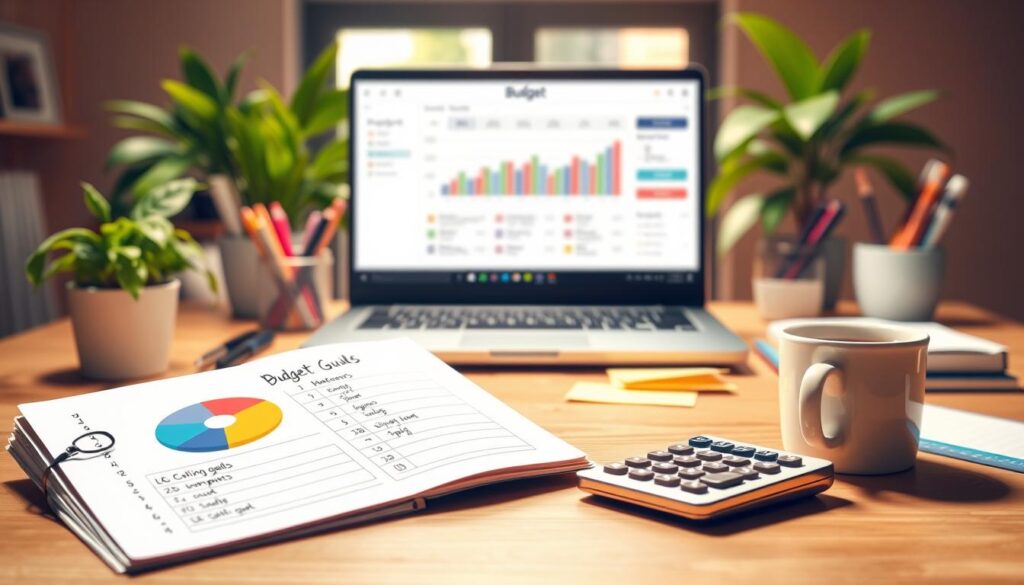
Clear goals give a budget purpose and help make trade-offs easier to evaluate. They help separate needs from wants. These goals guide choices about saving, spending, and paying off debt.
A practical budget planning guide centers on goals that match life priorities. It also considers available financial planning resources.
Short-Term vs. Long-Term Goals
Short-term goals last from weeks up to two years. Examples are building a $1,000 emergency fund, paying off credit card debt, or saving for a summer trip.
These goals use immediate money-saving strategies and often need quick wins. Long-term goals last beyond three years. Common goals include a home down payment and retirement savings with Vanguard or Fidelity.
Funding a child’s college is also a long-term goal. Intermediate goals, like buying a reliable car or starting a small business, sit between short and long horizons.
SMART Goals for Budgeting
The SMART framework turns vague aims into clear plans. Each goal should be Specific, Measurable, Achievable, Relevant, and Time-bound. For example, change “save more” to “save $5,000 for a down payment in 18 months by setting aside $278 per month.”
Use timelines and target amounts to set monthly savings. Create separate sinking funds or sub-accounts at Chase or Bank of America for each goal. This helps track progress and avoid accidental spending.
Measure progress with checkpoints like monthly savings rate, debt milestones, or percentage toward a target. Track these in a spreadsheet, budgeting app such as YNAB or Mint, or bank sub-accounts.
These financial tools keep momentum and show when to adjust priorities. Prioritize goals by urgency and impact. Rank essentials like an emergency fund above discretionary aims.
Rebalance goals when income changes or expenses rise. Using clear targets and steady money-saving helps ensure progress without losing focus on daily needs.
Assessing Your Current Financial Situation
Before creating a budget, it is important to have a clear baseline. This baseline shows monthly net income and spending patterns. It helps you use financial planning resources effectively.
Gather your documents and use a simple budget template. This will turn your raw numbers into a clear summary.
Tracking Income
List every income source such as W-2 wages, 1099 or gig pay, child support, dividends, and rental receipts. Use net pay after taxes for monthly planning. Review pay stubs, bank deposits, and recent tax returns to confirm averages.
If your earnings vary, choose a conservative estimate. Use a rolling 12-month average or the lower monthly figure. Recording each source in a budget template makes later calculations simpler.
Evaluating Expenses
Categorize spending into fixed, variable, and periodic items. Fixed costs include rent or mortgage and insurance. Variable costs cover groceries, gas, and entertainment. Periodic expenses include annual subscriptions, vehicle registration, or holiday gifts.
Collect three to six months of bank and credit card statements, receipts, and app exports. Use tracking tools like Mint, YNAB, or Personal Capital to auto-categorize transactions. These tools also flag recurring subscriptions like Netflix, Hulu, or gym memberships.
Calculate average monthly spending for each category: housing, transportation, food, utilities, entertainment, healthcare, insurance, and debt payments. Look for spikes or seasonal changes that affect cash flow. This analysis helps guide personal finance advice.
Create a one-page summary showing monthly net income, total fixed costs, and average variable expenses. Include the resulting surplus or deficit. Use this page with financial planning resources to set goals and create an actionable budget.
Creating Your Budget
Choosing the right approach makes a budget work well. The best choice depends on your goals, discipline, and finances.
This guide shows clear options. Try one method for at least two months before switching to another.
Choosing a Budgeting Method
There are many popular budgeting methods to consider. Rule-based systems use percentages, while envelope systems, pay-yourself-first plans, and zero-based budgeting offer different styles.
Each method trades off simplicity and control. Pick one method, set up category budgets, and schedule automatic transfers for bills and savings.
Use sinking funds for irregular expenses. You can combine methods too, like using rules for shares and zero-based budgeting inside categories.
These steps follow proven money management tips that boost consistency.
The 50/30/20 Rule
This framework divides after-tax income into needs, wants, and savings. Needs get 50% for housing, food, utilities, and debt.
Wants take 30% for dining out, subscriptions, and entertainment. Savings and debt payments use 20%.
This method is clear and flexible but can struggle if living costs are high or you want to save more aggressively.
For example, with $4,000 monthly net pay: needs = $2,000, wants = $1,200, savings/debt = $800. Adjust percentages if rent or loans push needs higher.
Zero-Based Budgeting
Zero-based budgeting gives every dollar a job. Income minus expenses equals zero.
People list categories and allocate exact amounts, including savings and debt payoff. This offers precise control and accountability.
A drawback is the time needed. Setting up and updating this plan takes effort every cycle.
This suits those wanting tight oversight or managing irregular income. It works well with automated transfers to enforce budgets.
Practical implementation tips across methods:
- Create clear category budgets for housing, food, transport, savings, and fun.
- Automate transfers to savings accounts and bill payments to reduce manual work.
- Use sinking funds for irregular expenses like car maintenance or annual insurance.
- Test one method for two months before changing to another, tracking results.
Budget templates help you start quickly. Trusted templates from major banks or blogs offer adaptable layouts.
The IRS provides resources to plan tax-related items, helping with category choices. Templates adjust for different income levels and household sizes.
| Method | Best For | Pros | Cons | Practical Tip |
|---|---|---|---|---|
| 50/30/20 | Beginners and steady incomes | Simple, flexible, quick to set up | May not suit high-cost areas or aggressive savers | Adjust percentages for local housing costs |
| Zero-Based | People who want detailed control | Precise allocation, strong accountability | Time-consuming to maintain | Pair with auto-transfers for enforcement |
| Envelope System | Cash users and visual spenders | Limits overspending, tactile control | Less convenient with digital payments | Use virtual envelopes in apps if needed |
| Pay-Yourself-First | Savers and goal-focused people | Builds savings habit quickly | Might squeeze living expenses if income is low | Automate transfers to savings on payday |
This budget guide blends practical methods with actionable tips. Testing and adapting your system helps keep progress toward your financial goals.
Tools to Help You Budget
Technology makes tracking money easier. A few good budgeting tools speed up categorization, automate tasks, and show clear visual reports. Readers should pick tools that fit their habits and privacy comfort.
Spreadsheet Software
Programs like Microsoft Excel, Google Sheets, and Apple Numbers allow full customization for personal budgets. Users can create monthly budgets, cash flow sheets, or debt tables.
Templates and community files save time. Formula shortcuts like SUMIFS and pivot tables automate summaries and categorization.
A good budget template cuts setup work but keeps control.
Budgeting Apps
Mobile and web apps link bank accounts, categorize spending in real time, and track goals. Mint offers free aggregation and alerts. You Need A Budget (YNAB) teaches zero-based budgeting and hands-on routines.
Personal Capital focuses on net worth and investments. EveryDollar and PocketGuard help with quick monthly planning. Users should check encryption, subscription costs, and data-sharing before linking accounts.
Online Calculators
Reliable calculators set realistic financial goals. Tools for loan repayment, debt payoff, savings growth, and retirement give clear timelines. The Consumer Financial Protection Bureau and major finance sites offer worksheets and examples.
Readers can use calculators to find monthly savings goals, estimate payoff dates, and plan for irregular expenses. Saving these resources in bookmarks helps with future changes.
Automation keeps budgets updated. Linking accounts, scheduling transfers, and setting app notifications reduce manual work and improve consistency.
Next steps: try one spreadsheet template and one budgeting app. Then bookmark several online calculators. These steps provide tools for confident money management.
How to Monitor Your Budget
Monitoring your budget helps turn a plan into steady progress. Regular reviews stop overspending and reveal spending patterns.
These reviews also keep your goals on track. Readers will find practical routines, clear metrics, and simple tools.
These tools make monitoring repeatable and useful.
Regular Check-Ins
Weekly quick checks help catch errors and categorize new transactions. Spending 10–20 minutes prevents small issues from becoming big problems.
Recommended weekly checklist:
- Confirm automated transfers and savings deposits.
- Verify recent bill payments cleared.
- Categorize uncategorized transactions in budgeting tools.
- Flag any unusual charges for follow-up.
Monthly in-depth reviews reconcile accounts and compare actual spending to the budget. Use budgeting tools, bank statements, and receipts to match planned amounts.
Monthly checklist:
- Reconcile checking and credit card balances.
- Calculate monthly surplus or deficit.
- Update category budgets based on trends.
- Record notes on any deviations and causes.
Quarterly reviews focus on your progress and priority shifts. Use this time to check if strategies or resources need changing.
Quarterly checklist:
- Measure savings rate and percent of income saved.
- Review debt balances and credit card use.
- Compare major expense trends across months.
- Adjust targets for the next quarter if needed.
Adapting Your Budget
Budgets need change when income shifts or new recurring costs appear. Adaptation keeps the plan realistic without losing discipline.
Steps to adjust the budget:
- Identify the trigger: pay raise, job change, new subscription, or life event.
- Reallocate funds for new needs before increasing spending on extras.
- Update savings targets and track the impact for one cycle.
- Trim discretionary categories if shortfalls continue.
Write down every change with the reason and date. Testing changes for at least one month shows if shifts are sustainable.
Key metrics to watch:
| Metric | Why It Matters | How to Monitor |
|---|---|---|
| Monthly surplus/deficit | Shows if spending matches income | Compare total income to total expenses monthly |
| Savings rate (%) | Measures progress toward goals | Divide monthly savings by gross income |
| Debt balances | Tracks payoff progress and interest risk | List balances and compare month to month |
| Credit utilization | Affects credit score and borrowing costs | Monitor card balances versus limits; check free services like Credit Karma |
| Major expense trends | Shows categories growing over time | Use budgeting tools or spreadsheet charts to view trends |
Practical monitoring tips:
- Set alerts in banking apps for low balances and large transactions.
- Use spreadsheet dashboards or reports from budgeting tools to see trends.
- Automate bill payments and savings to reduce decision fatigue.
- Set recurring reminders for weekly, monthly, and quarterly reviews.
These steps combine clear routines with money management tips and planning resources. Consistent monitoring makes budgets strong and helps people stick to goals.
Cutting Unnecessary Expenses
The first step in reducing spending is a calm review of recent bank and card statements. They show small charges, impulse buys, and little subscriptions that add up. Categorize each recurring payment as essential, negotiable, or removable to find leaks in your budget.
Identifying Non-Essential Spending
Review three to six months of transactions to find spending patterns. Look for frequent dining out, premium cable, underused gym memberships, streaming services, and repeated delivery fees. Track credit card interest and fees that reduce your savings.
Classify subscriptions and small charges. Mark anything not used regularly as removable. Label bills that can be renegotiated as negotiable. Mark true essentials as essential. This simple triage makes cost-cutting easier to apply.
Tips for Reducing Costs
Call service providers like Comcast, Verizon, Geico, or Progressive to ask for lower rates or promotional plans. Use Rocket Money to find and cancel unwanted subscriptions. Negotiation can reduce monthly expenses.
Downgrade or consolidate where possible. Combine streaming plans into one family plan. Consolidate credit card debt with lower-interest loans or balance transfers to save on interest.
Shop smarter for groceries and household goods. Use a list, buy generic brands, plan meals, and clip coupons. Use cashback apps and price comparison tools to stretch each dollar.
Make energy changes. Swap to LED bulbs, add a programmable thermostat, and seal drafts to lower heating and cooling bills. These steps save steadily over time.
Cut transportation costs by carpooling, taking public transit, or comparing car insurance rates. Check discounts from State Farm and others to reduce premiums without losing coverage.
Change spending habits to prevent waste. Use a 48-hour cooling-off rule for nonessential buys. Try cash envelopes for dining out and entertainment. Set a small monthly fun-money limit to avoid impulse purchases.
Project small cuts into yearly savings. Canceling one $30 monthly subscription saves about $360 per year. Reducing dining out by $50 a month adds $600 annually. These examples show how saving money compounds quickly.
Create an action plan with three to five priority changes for the next 30 days. Track actual savings monthly and reallocate those funds to debt repayment or an emergency fund. This turns short-term effort into lasting personal finance success.
Planning for Irregular Expenses
An organized approach to irregular expenses helps keep your budget steady when unexpected bills arrive. Readers will learn practical steps to track non-monthly costs. They will also learn how to set aside small sums each month using a simple budget template for clarity.
Understanding irregular expenses
Irregular expenses are costs that do not happen every month. Examples include annual insurance premiums, car maintenance, holiday gifts, property taxes, and medical co-pays. These costs can disrupt your plans if ignored.
One useful tactic is a sinking fund. It means creating separate sub-accounts or categories for each expense. Calculate by dividing the expected cost by the months until payment is due to find the monthly contribution.
Creating an emergency fund
An emergency fund covers urgent events like job loss, major medical bills, or sudden home repairs. Start with a small goal of $1,000 for immediate emergencies.
After the starter goal, aim for three months of essential expenses for single-income homes. Dual-earner households or those with higher risk should target six months or more. Use high-yield savings accounts from Ally, Marcus by Goldman Sachs, or Discover for easy access and interest. Avoid investing emergency money in stocks due to market ups and downs.
Funding strategies include automatic transfers, round-ups on spending apps, and saving part of tax refunds or bonuses. Prioritize building a starter emergency fund before aggressive debt repayment while keeping minimum payments current.
For reliable guidance, consult financial resources about sinking funds, emergency savings, and budget templates. Small, consistent actions make irregular costs manageable and lower stress when surprises happen.
Adjusting Your Budget as Needed
Budgets work best when they change with life. A budget planning guide should treat plans as living documents. Small updates keep goals realistic and spending in line with priorities.
Life Changes and Financial Shifts
Major events trigger a quick review. Job loss, a new position, salary changes, marriage, divorce, childbirth, moving, medical bills, or big purchases all require action.
The first step is to recalculate net income. This helps you see your current cash flow clearly.
Next, adjust the emergency fund to match new risk levels. Check recurring bills and ask for lower service rates. Update debt repayment plans to avoid missed payments and extra interest.
Reassessing Goals and Spending
Review short- and long-term goals at least once a year or after major life events. Adjust timelines, contribution amounts, and priorities to fit your new circumstances.
Use goal-tracking features in budgeting apps or a custom spreadsheet to measure your progress. Scenario planning helps you prepare for uncertainty.
If income drops, plan cuts to discretionary spending. Pause nonessential subscriptions and reduce dining out. For a windfall, split the money wisely.
Pay high-interest debt, boost savings, and set aside a small share for enjoyment. Household communication matters.
Partners should discuss changes, align priorities, and record shared responsibilities. Clear roles reduce confusion and keep the plan actionable.
Practical checklist for adjustments:
- Review current income and update numbers.
- Update fixed and recurring expenses.
- Recalculate savings targets and debt payments.
- Reassign sinking funds for irregular expenses.
- Schedule a follow-up review date to assess impact.
Readers benefit from using financial planning resources. Templates, calculators, and expert advice keep the budget useful and aligned with priorities.
Staying Motivated and Committed
Long-term budgeting works best when your habits and mindset match. Regular rituals, like a review on the first Sunday each month, help. Visual tracking also makes progress feel real and rewarding.
Use behavioral tools such as automating transfers and habit trackers to keep momentum. Breaking big goals into small steps reduces stress and boosts success.
Finding Support
Support can come from books like The Total Money Makeover by Dave Ramsey or Your Money or Your Life by Vicki Robin. Online forums, such as Reddit personal finance communities, offer advice too. Local counselors from the National Foundation for Credit Counseling provide help as well.
For complex cases, a certified financial planner offers personalized advice. Couples’ budgeting sessions or having an accountability partner also improve results and commitment.
Celebrating Small Wins
Marking short-term milestones keeps the process sustainable. Examples include paying off a small debt, saving a set amount, or canceling unwanted subscriptions. Low-cost rewards like a weekend outing or favorite meal keep motivation high without breaking the budget.
Stay engaged by linking spending to your values. Use budgeting apps and templates, then schedule your next review. This keeps accountability strong and builds money management skills steadily over time.
FAQ
What is a budget and why is it important?
Who will benefit from this budget planning guide?
How should someone start assessing their current financial situation?
What budgeting methods work best for beginners?
How can someone choose between the 50/30/20 rule and zero-based budgeting?
What tools help with budgeting and tracking?
How often should someone monitor and adjust their budget?
How can one plan for irregular expenses like annual insurance or car repairs?
FAQ
What is a budget and why is it important?
A budget plans how to use your net income for expenses, savings, and debt repayment, usually monthly. It helps avoid overspending and build emergency savings. Budgeting also lowers financial stress and clarifies your priorities.
Regular budgeting improves cash flow and reduces reliance on credit. It supports progress toward goals like buying a home or saving for retirement.
Who will benefit from this budget planning guide?
This guide is for students, early-career professionals, families, gig workers, and anyone in the U.S. wanting clearer money management. Readers will learn how to track income and expenses and choose a budgeting method.
It also covers building an emergency fund, creating sinking funds for irregular costs, and meeting financial goals both short- and long-term.
How should someone start assessing their current financial situation?
Start by gathering recent pay stubs, bank and credit card statements, and tax documents. Calculate your average monthly net income. Then categorize expenses into fixed, variable, and irregular types.
Compute average monthly spending for each category. Create a one-page summary showing net income, total fixed costs, and average variable costs. Use this summary to plan your budget.
What budgeting methods work best for beginners?
Beginners often use simple frameworks like the 50/30/20 rule or zero-based budgeting. The 50/30/20 rule allocates 50% to needs, 30% to wants, and 20% to savings and debt.
Zero-based budgeting assigns every dollar a job so income minus expenses equals zero. Try one method for at least two months to see what works best for you.
How can someone choose between the 50/30/20 rule and zero-based budgeting?
Choose based on your goals and discipline. Use 50/30/20 for simplicity and flexibility. It’s good for steady incomes and casual tracking.
Use zero-based budgeting for precise control and accountability. It fits aggressive savers or those with complex finances. Many combine both methods for balance.
What tools help with budgeting and tracking?
Spreadsheet software like Google Sheets and Excel offers customization and templates. Budgeting apps like Mint, You Need A Budget (YNAB), Personal Capital, EveryDollar, and PocketGuard automate categorization and track goals.
Online calculators from Bankrate, NerdWallet, and the Consumer Financial Protection Bureau model loan payments, savings growth, and emergency fund targets.
How often should someone monitor and adjust their budget?
Perform weekly quick check-ins to categorize transactions. Do monthly in-depth reviews to reconcile accounts and compare actual spending to your budget.
Quarterly reviews help track progress toward goals. Adjust your budget after income changes, new expenses, or life events. Test changes before making them permanent.
How can one plan for irregular expenses like annual insurance or car repairs?
Use sinking funds by creating sub-accounts or spreadsheet categories for specific irregular costs. Calculate how much to save each month by dividing the expense by months until due.
Automate these transfers to save effortlessly. Keep a starter emergency fund of about
FAQ
What is a budget and why is it important?
A budget plans how to use your net income for expenses, savings, and debt repayment, usually monthly. It helps avoid overspending and build emergency savings. Budgeting also lowers financial stress and clarifies your priorities.
Regular budgeting improves cash flow and reduces reliance on credit. It supports progress toward goals like buying a home or saving for retirement.
Who will benefit from this budget planning guide?
This guide is for students, early-career professionals, families, gig workers, and anyone in the U.S. wanting clearer money management. Readers will learn how to track income and expenses and choose a budgeting method.
It also covers building an emergency fund, creating sinking funds for irregular costs, and meeting financial goals both short- and long-term.
How should someone start assessing their current financial situation?
Start by gathering recent pay stubs, bank and credit card statements, and tax documents. Calculate your average monthly net income. Then categorize expenses into fixed, variable, and irregular types.
Compute average monthly spending for each category. Create a one-page summary showing net income, total fixed costs, and average variable costs. Use this summary to plan your budget.
What budgeting methods work best for beginners?
Beginners often use simple frameworks like the 50/30/20 rule or zero-based budgeting. The 50/30/20 rule allocates 50% to needs, 30% to wants, and 20% to savings and debt.
Zero-based budgeting assigns every dollar a job so income minus expenses equals zero. Try one method for at least two months to see what works best for you.
How can someone choose between the 50/30/20 rule and zero-based budgeting?
Choose based on your goals and discipline. Use 50/30/20 for simplicity and flexibility. It’s good for steady incomes and casual tracking.
Use zero-based budgeting for precise control and accountability. It fits aggressive savers or those with complex finances. Many combine both methods for balance.
What tools help with budgeting and tracking?
Spreadsheet software like Google Sheets and Excel offers customization and templates. Budgeting apps like Mint, You Need A Budget (YNAB), Personal Capital, EveryDollar, and PocketGuard automate categorization and track goals.
Online calculators from Bankrate, NerdWallet, and the Consumer Financial Protection Bureau model loan payments, savings growth, and emergency fund targets.
How often should someone monitor and adjust their budget?
Perform weekly quick check-ins to categorize transactions. Do monthly in-depth reviews to reconcile accounts and compare actual spending to your budget.
Quarterly reviews help track progress toward goals. Adjust your budget after income changes, new expenses, or life events. Test changes before making them permanent.
How can one plan for irregular expenses like annual insurance or car repairs?
Use sinking funds by creating sub-accounts or spreadsheet categories for specific irregular costs. Calculate how much to save each month by dividing the expense by months until due.
Automate these transfers to save effortlessly. Keep a starter emergency fund of about $1,000. Then build toward 3–6 months of expenses in a high-yield savings account for major surprises.
What are effective strategies to cut unnecessary expenses?
Identify small recurring charges and unused subscriptions by reviewing 3–6 months of statements. Negotiate service rates and downgrade plans where possible.
Consolidate debt, use grocery lists and generic brands, save energy, compare insurance rates, and wait before buying nonessential items. Focus on 3–5 changes and track your savings monthly.
How much should be saved for an emergency fund and where to keep it?
Begin with a $1,000 starter fund. Then aim for 3 months of essential living expenses, or 6+ months for higher risks or single-income households.
Keep emergency funds in liquid, low-risk accounts like high-yield savings or money market accounts. Avoid investing emergency money in stocks.
How can budgets be adjusted after major life changes?
Recalculate net income and update fixed expenses. Reprioritize emergency funds and debt repayment. Renegotiate recurring services and revise savings goals.
Create plans for income drops or windfalls. For households, communicate with partners, share responsibilities, and schedule reviews to evaluate impact.
What role do goals play in budgeting and how are SMART goals used?
Goals give budgets purpose and ease trade-offs. SMART goals are Specific, Measurable, Achievable, Relevant, and Time-bound.
Turn vague aims into SMART objectives. For example, “Save $5,000 in 18 months by setting aside $278 per month.” Use sinking funds and measurable milestones to track progress.
How can someone stay motivated to follow a budget long term?
Automate savings and bills to reduce effort. Find support through books, online communities, or financial counselors. Celebrate small wins with low-cost rewards.
Visualize progress with charts, break large goals into micro-goals, and create regular budget routines to keep momentum and positive habits.
Where can readers find budget templates and reliable financial planning resources?
Trusted sources include Google Sheets and Excel community templates, budgeting blogs, bank resources, and government or nonprofit calculators. Apps like YNAB, Mint, and Personal Capital offer built-in templates and goal trackers.
For counseling and education, the National Foundation for Credit Counseling (NFCC) and certified financial planners (CFP) provide professional guidance.
,000. Then build toward 3–6 months of expenses in a high-yield savings account for major surprises.
What are effective strategies to cut unnecessary expenses?
Identify small recurring charges and unused subscriptions by reviewing 3–6 months of statements. Negotiate service rates and downgrade plans where possible.
Consolidate debt, use grocery lists and generic brands, save energy, compare insurance rates, and wait before buying nonessential items. Focus on 3–5 changes and track your savings monthly.
How much should be saved for an emergency fund and where to keep it?
Begin with a
FAQ
What is a budget and why is it important?
A budget plans how to use your net income for expenses, savings, and debt repayment, usually monthly. It helps avoid overspending and build emergency savings. Budgeting also lowers financial stress and clarifies your priorities.
Regular budgeting improves cash flow and reduces reliance on credit. It supports progress toward goals like buying a home or saving for retirement.
Who will benefit from this budget planning guide?
This guide is for students, early-career professionals, families, gig workers, and anyone in the U.S. wanting clearer money management. Readers will learn how to track income and expenses and choose a budgeting method.
It also covers building an emergency fund, creating sinking funds for irregular costs, and meeting financial goals both short- and long-term.
How should someone start assessing their current financial situation?
Start by gathering recent pay stubs, bank and credit card statements, and tax documents. Calculate your average monthly net income. Then categorize expenses into fixed, variable, and irregular types.
Compute average monthly spending for each category. Create a one-page summary showing net income, total fixed costs, and average variable costs. Use this summary to plan your budget.
What budgeting methods work best for beginners?
Beginners often use simple frameworks like the 50/30/20 rule or zero-based budgeting. The 50/30/20 rule allocates 50% to needs, 30% to wants, and 20% to savings and debt.
Zero-based budgeting assigns every dollar a job so income minus expenses equals zero. Try one method for at least two months to see what works best for you.
How can someone choose between the 50/30/20 rule and zero-based budgeting?
Choose based on your goals and discipline. Use 50/30/20 for simplicity and flexibility. It’s good for steady incomes and casual tracking.
Use zero-based budgeting for precise control and accountability. It fits aggressive savers or those with complex finances. Many combine both methods for balance.
What tools help with budgeting and tracking?
Spreadsheet software like Google Sheets and Excel offers customization and templates. Budgeting apps like Mint, You Need A Budget (YNAB), Personal Capital, EveryDollar, and PocketGuard automate categorization and track goals.
Online calculators from Bankrate, NerdWallet, and the Consumer Financial Protection Bureau model loan payments, savings growth, and emergency fund targets.
How often should someone monitor and adjust their budget?
Perform weekly quick check-ins to categorize transactions. Do monthly in-depth reviews to reconcile accounts and compare actual spending to your budget.
Quarterly reviews help track progress toward goals. Adjust your budget after income changes, new expenses, or life events. Test changes before making them permanent.
How can one plan for irregular expenses like annual insurance or car repairs?
Use sinking funds by creating sub-accounts or spreadsheet categories for specific irregular costs. Calculate how much to save each month by dividing the expense by months until due.
Automate these transfers to save effortlessly. Keep a starter emergency fund of about $1,000. Then build toward 3–6 months of expenses in a high-yield savings account for major surprises.
What are effective strategies to cut unnecessary expenses?
Identify small recurring charges and unused subscriptions by reviewing 3–6 months of statements. Negotiate service rates and downgrade plans where possible.
Consolidate debt, use grocery lists and generic brands, save energy, compare insurance rates, and wait before buying nonessential items. Focus on 3–5 changes and track your savings monthly.
How much should be saved for an emergency fund and where to keep it?
Begin with a $1,000 starter fund. Then aim for 3 months of essential living expenses, or 6+ months for higher risks or single-income households.
Keep emergency funds in liquid, low-risk accounts like high-yield savings or money market accounts. Avoid investing emergency money in stocks.
How can budgets be adjusted after major life changes?
Recalculate net income and update fixed expenses. Reprioritize emergency funds and debt repayment. Renegotiate recurring services and revise savings goals.
Create plans for income drops or windfalls. For households, communicate with partners, share responsibilities, and schedule reviews to evaluate impact.
What role do goals play in budgeting and how are SMART goals used?
Goals give budgets purpose and ease trade-offs. SMART goals are Specific, Measurable, Achievable, Relevant, and Time-bound.
Turn vague aims into SMART objectives. For example, “Save $5,000 in 18 months by setting aside $278 per month.” Use sinking funds and measurable milestones to track progress.
How can someone stay motivated to follow a budget long term?
Automate savings and bills to reduce effort. Find support through books, online communities, or financial counselors. Celebrate small wins with low-cost rewards.
Visualize progress with charts, break large goals into micro-goals, and create regular budget routines to keep momentum and positive habits.
Where can readers find budget templates and reliable financial planning resources?
Trusted sources include Google Sheets and Excel community templates, budgeting blogs, bank resources, and government or nonprofit calculators. Apps like YNAB, Mint, and Personal Capital offer built-in templates and goal trackers.
For counseling and education, the National Foundation for Credit Counseling (NFCC) and certified financial planners (CFP) provide professional guidance.
,000 starter fund. Then aim for 3 months of essential living expenses, or 6+ months for higher risks or single-income households.
Keep emergency funds in liquid, low-risk accounts like high-yield savings or money market accounts. Avoid investing emergency money in stocks.
How can budgets be adjusted after major life changes?
Recalculate net income and update fixed expenses. Reprioritize emergency funds and debt repayment. Renegotiate recurring services and revise savings goals.
Create plans for income drops or windfalls. For households, communicate with partners, share responsibilities, and schedule reviews to evaluate impact.
What role do goals play in budgeting and how are SMART goals used?
Goals give budgets purpose and ease trade-offs. SMART goals are Specific, Measurable, Achievable, Relevant, and Time-bound.
Turn vague aims into SMART objectives. For example, “Save ,000 in 18 months by setting aside 8 per month.” Use sinking funds and measurable milestones to track progress.
How can someone stay motivated to follow a budget long term?
Automate savings and bills to reduce effort. Find support through books, online communities, or financial counselors. Celebrate small wins with low-cost rewards.
Visualize progress with charts, break large goals into micro-goals, and create regular budget routines to keep momentum and positive habits.
Where can readers find budget templates and reliable financial planning resources?
Trusted sources include Google Sheets and Excel community templates, budgeting blogs, bank resources, and government or nonprofit calculators. Apps like YNAB, Mint, and Personal Capital offer built-in templates and goal trackers.
For counseling and education, the National Foundation for Credit Counseling (NFCC) and certified financial planners (CFP) provide professional guidance.
FAQ
What is a budget and why is it important?
A budget plans how to use your net income for expenses, savings, and debt repayment, usually monthly. It helps avoid overspending and build emergency savings. Budgeting also lowers financial stress and clarifies your priorities.
Regular budgeting improves cash flow and reduces reliance on credit. It supports progress toward goals like buying a home or saving for retirement.
Who will benefit from this budget planning guide?
This guide is for students, early-career professionals, families, gig workers, and anyone in the U.S. wanting clearer money management. Readers will learn how to track income and expenses and choose a budgeting method.
It also covers building an emergency fund, creating sinking funds for irregular costs, and meeting financial goals both short- and long-term.
How should someone start assessing their current financial situation?
Start by gathering recent pay stubs, bank and credit card statements, and tax documents. Calculate your average monthly net income. Then categorize expenses into fixed, variable, and irregular types.
Compute average monthly spending for each category. Create a one-page summary showing net income, total fixed costs, and average variable costs. Use this summary to plan your budget.
What budgeting methods work best for beginners?
Beginners often use simple frameworks like the 50/30/20 rule or zero-based budgeting. The 50/30/20 rule allocates 50% to needs, 30% to wants, and 20% to savings and debt.
Zero-based budgeting assigns every dollar a job so income minus expenses equals zero. Try one method for at least two months to see what works best for you.
How can someone choose between the 50/30/20 rule and zero-based budgeting?
Choose based on your goals and discipline. Use 50/30/20 for simplicity and flexibility. It’s good for steady incomes and casual tracking.
Use zero-based budgeting for precise control and accountability. It fits aggressive savers or those with complex finances. Many combine both methods for balance.
What tools help with budgeting and tracking?
Spreadsheet software like Google Sheets and Excel offers customization and templates. Budgeting apps like Mint, You Need A Budget (YNAB), Personal Capital, EveryDollar, and PocketGuard automate categorization and track goals.
Online calculators from Bankrate, NerdWallet, and the Consumer Financial Protection Bureau model loan payments, savings growth, and emergency fund targets.
How often should someone monitor and adjust their budget?
Perform weekly quick check-ins to categorize transactions. Do monthly in-depth reviews to reconcile accounts and compare actual spending to your budget.
Quarterly reviews help track progress toward goals. Adjust your budget after income changes, new expenses, or life events. Test changes before making them permanent.
How can one plan for irregular expenses like annual insurance or car repairs?
Use sinking funds by creating sub-accounts or spreadsheet categories for specific irregular costs. Calculate how much to save each month by dividing the expense by months until due.
Automate these transfers to save effortlessly. Keep a starter emergency fund of about
FAQ
What is a budget and why is it important?
A budget plans how to use your net income for expenses, savings, and debt repayment, usually monthly. It helps avoid overspending and build emergency savings. Budgeting also lowers financial stress and clarifies your priorities.
Regular budgeting improves cash flow and reduces reliance on credit. It supports progress toward goals like buying a home or saving for retirement.
Who will benefit from this budget planning guide?
This guide is for students, early-career professionals, families, gig workers, and anyone in the U.S. wanting clearer money management. Readers will learn how to track income and expenses and choose a budgeting method.
It also covers building an emergency fund, creating sinking funds for irregular costs, and meeting financial goals both short- and long-term.
How should someone start assessing their current financial situation?
Start by gathering recent pay stubs, bank and credit card statements, and tax documents. Calculate your average monthly net income. Then categorize expenses into fixed, variable, and irregular types.
Compute average monthly spending for each category. Create a one-page summary showing net income, total fixed costs, and average variable costs. Use this summary to plan your budget.
What budgeting methods work best for beginners?
Beginners often use simple frameworks like the 50/30/20 rule or zero-based budgeting. The 50/30/20 rule allocates 50% to needs, 30% to wants, and 20% to savings and debt.
Zero-based budgeting assigns every dollar a job so income minus expenses equals zero. Try one method for at least two months to see what works best for you.
How can someone choose between the 50/30/20 rule and zero-based budgeting?
Choose based on your goals and discipline. Use 50/30/20 for simplicity and flexibility. It’s good for steady incomes and casual tracking.
Use zero-based budgeting for precise control and accountability. It fits aggressive savers or those with complex finances. Many combine both methods for balance.
What tools help with budgeting and tracking?
Spreadsheet software like Google Sheets and Excel offers customization and templates. Budgeting apps like Mint, You Need A Budget (YNAB), Personal Capital, EveryDollar, and PocketGuard automate categorization and track goals.
Online calculators from Bankrate, NerdWallet, and the Consumer Financial Protection Bureau model loan payments, savings growth, and emergency fund targets.
How often should someone monitor and adjust their budget?
Perform weekly quick check-ins to categorize transactions. Do monthly in-depth reviews to reconcile accounts and compare actual spending to your budget.
Quarterly reviews help track progress toward goals. Adjust your budget after income changes, new expenses, or life events. Test changes before making them permanent.
How can one plan for irregular expenses like annual insurance or car repairs?
Use sinking funds by creating sub-accounts or spreadsheet categories for specific irregular costs. Calculate how much to save each month by dividing the expense by months until due.
Automate these transfers to save effortlessly. Keep a starter emergency fund of about $1,000. Then build toward 3–6 months of expenses in a high-yield savings account for major surprises.
What are effective strategies to cut unnecessary expenses?
Identify small recurring charges and unused subscriptions by reviewing 3–6 months of statements. Negotiate service rates and downgrade plans where possible.
Consolidate debt, use grocery lists and generic brands, save energy, compare insurance rates, and wait before buying nonessential items. Focus on 3–5 changes and track your savings monthly.
How much should be saved for an emergency fund and where to keep it?
Begin with a $1,000 starter fund. Then aim for 3 months of essential living expenses, or 6+ months for higher risks or single-income households.
Keep emergency funds in liquid, low-risk accounts like high-yield savings or money market accounts. Avoid investing emergency money in stocks.
How can budgets be adjusted after major life changes?
Recalculate net income and update fixed expenses. Reprioritize emergency funds and debt repayment. Renegotiate recurring services and revise savings goals.
Create plans for income drops or windfalls. For households, communicate with partners, share responsibilities, and schedule reviews to evaluate impact.
What role do goals play in budgeting and how are SMART goals used?
Goals give budgets purpose and ease trade-offs. SMART goals are Specific, Measurable, Achievable, Relevant, and Time-bound.
Turn vague aims into SMART objectives. For example, “Save $5,000 in 18 months by setting aside $278 per month.” Use sinking funds and measurable milestones to track progress.
How can someone stay motivated to follow a budget long term?
Automate savings and bills to reduce effort. Find support through books, online communities, or financial counselors. Celebrate small wins with low-cost rewards.
Visualize progress with charts, break large goals into micro-goals, and create regular budget routines to keep momentum and positive habits.
Where can readers find budget templates and reliable financial planning resources?
Trusted sources include Google Sheets and Excel community templates, budgeting blogs, bank resources, and government or nonprofit calculators. Apps like YNAB, Mint, and Personal Capital offer built-in templates and goal trackers.
For counseling and education, the National Foundation for Credit Counseling (NFCC) and certified financial planners (CFP) provide professional guidance.
,000. Then build toward 3–6 months of expenses in a high-yield savings account for major surprises.
What are effective strategies to cut unnecessary expenses?
Identify small recurring charges and unused subscriptions by reviewing 3–6 months of statements. Negotiate service rates and downgrade plans where possible.
Consolidate debt, use grocery lists and generic brands, save energy, compare insurance rates, and wait before buying nonessential items. Focus on 3–5 changes and track your savings monthly.
How much should be saved for an emergency fund and where to keep it?
Begin with a
FAQ
What is a budget and why is it important?
A budget plans how to use your net income for expenses, savings, and debt repayment, usually monthly. It helps avoid overspending and build emergency savings. Budgeting also lowers financial stress and clarifies your priorities.
Regular budgeting improves cash flow and reduces reliance on credit. It supports progress toward goals like buying a home or saving for retirement.
Who will benefit from this budget planning guide?
This guide is for students, early-career professionals, families, gig workers, and anyone in the U.S. wanting clearer money management. Readers will learn how to track income and expenses and choose a budgeting method.
It also covers building an emergency fund, creating sinking funds for irregular costs, and meeting financial goals both short- and long-term.
How should someone start assessing their current financial situation?
Start by gathering recent pay stubs, bank and credit card statements, and tax documents. Calculate your average monthly net income. Then categorize expenses into fixed, variable, and irregular types.
Compute average monthly spending for each category. Create a one-page summary showing net income, total fixed costs, and average variable costs. Use this summary to plan your budget.
What budgeting methods work best for beginners?
Beginners often use simple frameworks like the 50/30/20 rule or zero-based budgeting. The 50/30/20 rule allocates 50% to needs, 30% to wants, and 20% to savings and debt.
Zero-based budgeting assigns every dollar a job so income minus expenses equals zero. Try one method for at least two months to see what works best for you.
How can someone choose between the 50/30/20 rule and zero-based budgeting?
Choose based on your goals and discipline. Use 50/30/20 for simplicity and flexibility. It’s good for steady incomes and casual tracking.
Use zero-based budgeting for precise control and accountability. It fits aggressive savers or those with complex finances. Many combine both methods for balance.
What tools help with budgeting and tracking?
Spreadsheet software like Google Sheets and Excel offers customization and templates. Budgeting apps like Mint, You Need A Budget (YNAB), Personal Capital, EveryDollar, and PocketGuard automate categorization and track goals.
Online calculators from Bankrate, NerdWallet, and the Consumer Financial Protection Bureau model loan payments, savings growth, and emergency fund targets.
How often should someone monitor and adjust their budget?
Perform weekly quick check-ins to categorize transactions. Do monthly in-depth reviews to reconcile accounts and compare actual spending to your budget.
Quarterly reviews help track progress toward goals. Adjust your budget after income changes, new expenses, or life events. Test changes before making them permanent.
How can one plan for irregular expenses like annual insurance or car repairs?
Use sinking funds by creating sub-accounts or spreadsheet categories for specific irregular costs. Calculate how much to save each month by dividing the expense by months until due.
Automate these transfers to save effortlessly. Keep a starter emergency fund of about $1,000. Then build toward 3–6 months of expenses in a high-yield savings account for major surprises.
What are effective strategies to cut unnecessary expenses?
Identify small recurring charges and unused subscriptions by reviewing 3–6 months of statements. Negotiate service rates and downgrade plans where possible.
Consolidate debt, use grocery lists and generic brands, save energy, compare insurance rates, and wait before buying nonessential items. Focus on 3–5 changes and track your savings monthly.
How much should be saved for an emergency fund and where to keep it?
Begin with a $1,000 starter fund. Then aim for 3 months of essential living expenses, or 6+ months for higher risks or single-income households.
Keep emergency funds in liquid, low-risk accounts like high-yield savings or money market accounts. Avoid investing emergency money in stocks.
How can budgets be adjusted after major life changes?
Recalculate net income and update fixed expenses. Reprioritize emergency funds and debt repayment. Renegotiate recurring services and revise savings goals.
Create plans for income drops or windfalls. For households, communicate with partners, share responsibilities, and schedule reviews to evaluate impact.
What role do goals play in budgeting and how are SMART goals used?
Goals give budgets purpose and ease trade-offs. SMART goals are Specific, Measurable, Achievable, Relevant, and Time-bound.
Turn vague aims into SMART objectives. For example, “Save $5,000 in 18 months by setting aside $278 per month.” Use sinking funds and measurable milestones to track progress.
How can someone stay motivated to follow a budget long term?
Automate savings and bills to reduce effort. Find support through books, online communities, or financial counselors. Celebrate small wins with low-cost rewards.
Visualize progress with charts, break large goals into micro-goals, and create regular budget routines to keep momentum and positive habits.
Where can readers find budget templates and reliable financial planning resources?
Trusted sources include Google Sheets and Excel community templates, budgeting blogs, bank resources, and government or nonprofit calculators. Apps like YNAB, Mint, and Personal Capital offer built-in templates and goal trackers.
For counseling and education, the National Foundation for Credit Counseling (NFCC) and certified financial planners (CFP) provide professional guidance.
,000 starter fund. Then aim for 3 months of essential living expenses, or 6+ months for higher risks or single-income households.
Keep emergency funds in liquid, low-risk accounts like high-yield savings or money market accounts. Avoid investing emergency money in stocks.
How can budgets be adjusted after major life changes?
Recalculate net income and update fixed expenses. Reprioritize emergency funds and debt repayment. Renegotiate recurring services and revise savings goals.
Create plans for income drops or windfalls. For households, communicate with partners, share responsibilities, and schedule reviews to evaluate impact.
What role do goals play in budgeting and how are SMART goals used?
Goals give budgets purpose and ease trade-offs. SMART goals are Specific, Measurable, Achievable, Relevant, and Time-bound.
Turn vague aims into SMART objectives. For example, “Save ,000 in 18 months by setting aside 8 per month.” Use sinking funds and measurable milestones to track progress.
How can someone stay motivated to follow a budget long term?
Automate savings and bills to reduce effort. Find support through books, online communities, or financial counselors. Celebrate small wins with low-cost rewards.
Visualize progress with charts, break large goals into micro-goals, and create regular budget routines to keep momentum and positive habits.
Where can readers find budget templates and reliable financial planning resources?
Trusted sources include Google Sheets and Excel community templates, budgeting blogs, bank resources, and government or nonprofit calculators. Apps like YNAB, Mint, and Personal Capital offer built-in templates and goal trackers.
For counseling and education, the National Foundation for Credit Counseling (NFCC) and certified financial planners (CFP) provide professional guidance.
What are effective strategies to cut unnecessary expenses?
How much should be saved for an emergency fund and where to keep it?
FAQ
What is a budget and why is it important?
A budget plans how to use your net income for expenses, savings, and debt repayment, usually monthly. It helps avoid overspending and build emergency savings. Budgeting also lowers financial stress and clarifies your priorities.
Regular budgeting improves cash flow and reduces reliance on credit. It supports progress toward goals like buying a home or saving for retirement.
Who will benefit from this budget planning guide?
This guide is for students, early-career professionals, families, gig workers, and anyone in the U.S. wanting clearer money management. Readers will learn how to track income and expenses and choose a budgeting method.
It also covers building an emergency fund, creating sinking funds for irregular costs, and meeting financial goals both short- and long-term.
How should someone start assessing their current financial situation?
Start by gathering recent pay stubs, bank and credit card statements, and tax documents. Calculate your average monthly net income. Then categorize expenses into fixed, variable, and irregular types.
Compute average monthly spending for each category. Create a one-page summary showing net income, total fixed costs, and average variable costs. Use this summary to plan your budget.
What budgeting methods work best for beginners?
Beginners often use simple frameworks like the 50/30/20 rule or zero-based budgeting. The 50/30/20 rule allocates 50% to needs, 30% to wants, and 20% to savings and debt.
Zero-based budgeting assigns every dollar a job so income minus expenses equals zero. Try one method for at least two months to see what works best for you.
How can someone choose between the 50/30/20 rule and zero-based budgeting?
Choose based on your goals and discipline. Use 50/30/20 for simplicity and flexibility. It’s good for steady incomes and casual tracking.
Use zero-based budgeting for precise control and accountability. It fits aggressive savers or those with complex finances. Many combine both methods for balance.
What tools help with budgeting and tracking?
Spreadsheet software like Google Sheets and Excel offers customization and templates. Budgeting apps like Mint, You Need A Budget (YNAB), Personal Capital, EveryDollar, and PocketGuard automate categorization and track goals.
Online calculators from Bankrate, NerdWallet, and the Consumer Financial Protection Bureau model loan payments, savings growth, and emergency fund targets.
How often should someone monitor and adjust their budget?
Perform weekly quick check-ins to categorize transactions. Do monthly in-depth reviews to reconcile accounts and compare actual spending to your budget.
Quarterly reviews help track progress toward goals. Adjust your budget after income changes, new expenses, or life events. Test changes before making them permanent.
How can one plan for irregular expenses like annual insurance or car repairs?
Use sinking funds by creating sub-accounts or spreadsheet categories for specific irregular costs. Calculate how much to save each month by dividing the expense by months until due.
Automate these transfers to save effortlessly. Keep a starter emergency fund of about
FAQ
What is a budget and why is it important?
A budget plans how to use your net income for expenses, savings, and debt repayment, usually monthly. It helps avoid overspending and build emergency savings. Budgeting also lowers financial stress and clarifies your priorities.
Regular budgeting improves cash flow and reduces reliance on credit. It supports progress toward goals like buying a home or saving for retirement.
Who will benefit from this budget planning guide?
This guide is for students, early-career professionals, families, gig workers, and anyone in the U.S. wanting clearer money management. Readers will learn how to track income and expenses and choose a budgeting method.
It also covers building an emergency fund, creating sinking funds for irregular costs, and meeting financial goals both short- and long-term.
How should someone start assessing their current financial situation?
Start by gathering recent pay stubs, bank and credit card statements, and tax documents. Calculate your average monthly net income. Then categorize expenses into fixed, variable, and irregular types.
Compute average monthly spending for each category. Create a one-page summary showing net income, total fixed costs, and average variable costs. Use this summary to plan your budget.
What budgeting methods work best for beginners?
Beginners often use simple frameworks like the 50/30/20 rule or zero-based budgeting. The 50/30/20 rule allocates 50% to needs, 30% to wants, and 20% to savings and debt.
Zero-based budgeting assigns every dollar a job so income minus expenses equals zero. Try one method for at least two months to see what works best for you.
How can someone choose between the 50/30/20 rule and zero-based budgeting?
Choose based on your goals and discipline. Use 50/30/20 for simplicity and flexibility. It’s good for steady incomes and casual tracking.
Use zero-based budgeting for precise control and accountability. It fits aggressive savers or those with complex finances. Many combine both methods for balance.
What tools help with budgeting and tracking?
Spreadsheet software like Google Sheets and Excel offers customization and templates. Budgeting apps like Mint, You Need A Budget (YNAB), Personal Capital, EveryDollar, and PocketGuard automate categorization and track goals.
Online calculators from Bankrate, NerdWallet, and the Consumer Financial Protection Bureau model loan payments, savings growth, and emergency fund targets.
How often should someone monitor and adjust their budget?
Perform weekly quick check-ins to categorize transactions. Do monthly in-depth reviews to reconcile accounts and compare actual spending to your budget.
Quarterly reviews help track progress toward goals. Adjust your budget after income changes, new expenses, or life events. Test changes before making them permanent.
How can one plan for irregular expenses like annual insurance or car repairs?
Use sinking funds by creating sub-accounts or spreadsheet categories for specific irregular costs. Calculate how much to save each month by dividing the expense by months until due.
Automate these transfers to save effortlessly. Keep a starter emergency fund of about $1,000. Then build toward 3–6 months of expenses in a high-yield savings account for major surprises.
What are effective strategies to cut unnecessary expenses?
Identify small recurring charges and unused subscriptions by reviewing 3–6 months of statements. Negotiate service rates and downgrade plans where possible.
Consolidate debt, use grocery lists and generic brands, save energy, compare insurance rates, and wait before buying nonessential items. Focus on 3–5 changes and track your savings monthly.
How much should be saved for an emergency fund and where to keep it?
Begin with a $1,000 starter fund. Then aim for 3 months of essential living expenses, or 6+ months for higher risks or single-income households.
Keep emergency funds in liquid, low-risk accounts like high-yield savings or money market accounts. Avoid investing emergency money in stocks.
How can budgets be adjusted after major life changes?
Recalculate net income and update fixed expenses. Reprioritize emergency funds and debt repayment. Renegotiate recurring services and revise savings goals.
Create plans for income drops or windfalls. For households, communicate with partners, share responsibilities, and schedule reviews to evaluate impact.
What role do goals play in budgeting and how are SMART goals used?
Goals give budgets purpose and ease trade-offs. SMART goals are Specific, Measurable, Achievable, Relevant, and Time-bound.
Turn vague aims into SMART objectives. For example, “Save $5,000 in 18 months by setting aside $278 per month.” Use sinking funds and measurable milestones to track progress.
How can someone stay motivated to follow a budget long term?
Automate savings and bills to reduce effort. Find support through books, online communities, or financial counselors. Celebrate small wins with low-cost rewards.
Visualize progress with charts, break large goals into micro-goals, and create regular budget routines to keep momentum and positive habits.
Where can readers find budget templates and reliable financial planning resources?
Trusted sources include Google Sheets and Excel community templates, budgeting blogs, bank resources, and government or nonprofit calculators. Apps like YNAB, Mint, and Personal Capital offer built-in templates and goal trackers.
For counseling and education, the National Foundation for Credit Counseling (NFCC) and certified financial planners (CFP) provide professional guidance.
,000. Then build toward 3–6 months of expenses in a high-yield savings account for major surprises.
What are effective strategies to cut unnecessary expenses?
Identify small recurring charges and unused subscriptions by reviewing 3–6 months of statements. Negotiate service rates and downgrade plans where possible.
Consolidate debt, use grocery lists and generic brands, save energy, compare insurance rates, and wait before buying nonessential items. Focus on 3–5 changes and track your savings monthly.
How much should be saved for an emergency fund and where to keep it?
Begin with a
FAQ
What is a budget and why is it important?
A budget plans how to use your net income for expenses, savings, and debt repayment, usually monthly. It helps avoid overspending and build emergency savings. Budgeting also lowers financial stress and clarifies your priorities.
Regular budgeting improves cash flow and reduces reliance on credit. It supports progress toward goals like buying a home or saving for retirement.
Who will benefit from this budget planning guide?
This guide is for students, early-career professionals, families, gig workers, and anyone in the U.S. wanting clearer money management. Readers will learn how to track income and expenses and choose a budgeting method.
It also covers building an emergency fund, creating sinking funds for irregular costs, and meeting financial goals both short- and long-term.
How should someone start assessing their current financial situation?
Start by gathering recent pay stubs, bank and credit card statements, and tax documents. Calculate your average monthly net income. Then categorize expenses into fixed, variable, and irregular types.
Compute average monthly spending for each category. Create a one-page summary showing net income, total fixed costs, and average variable costs. Use this summary to plan your budget.
What budgeting methods work best for beginners?
Beginners often use simple frameworks like the 50/30/20 rule or zero-based budgeting. The 50/30/20 rule allocates 50% to needs, 30% to wants, and 20% to savings and debt.
Zero-based budgeting assigns every dollar a job so income minus expenses equals zero. Try one method for at least two months to see what works best for you.
How can someone choose between the 50/30/20 rule and zero-based budgeting?
Choose based on your goals and discipline. Use 50/30/20 for simplicity and flexibility. It’s good for steady incomes and casual tracking.
Use zero-based budgeting for precise control and accountability. It fits aggressive savers or those with complex finances. Many combine both methods for balance.
What tools help with budgeting and tracking?
Spreadsheet software like Google Sheets and Excel offers customization and templates. Budgeting apps like Mint, You Need A Budget (YNAB), Personal Capital, EveryDollar, and PocketGuard automate categorization and track goals.
Online calculators from Bankrate, NerdWallet, and the Consumer Financial Protection Bureau model loan payments, savings growth, and emergency fund targets.
How often should someone monitor and adjust their budget?
Perform weekly quick check-ins to categorize transactions. Do monthly in-depth reviews to reconcile accounts and compare actual spending to your budget.
Quarterly reviews help track progress toward goals. Adjust your budget after income changes, new expenses, or life events. Test changes before making them permanent.
How can one plan for irregular expenses like annual insurance or car repairs?
Use sinking funds by creating sub-accounts or spreadsheet categories for specific irregular costs. Calculate how much to save each month by dividing the expense by months until due.
Automate these transfers to save effortlessly. Keep a starter emergency fund of about $1,000. Then build toward 3–6 months of expenses in a high-yield savings account for major surprises.
What are effective strategies to cut unnecessary expenses?
Identify small recurring charges and unused subscriptions by reviewing 3–6 months of statements. Negotiate service rates and downgrade plans where possible.
Consolidate debt, use grocery lists and generic brands, save energy, compare insurance rates, and wait before buying nonessential items. Focus on 3–5 changes and track your savings monthly.
How much should be saved for an emergency fund and where to keep it?
Begin with a $1,000 starter fund. Then aim for 3 months of essential living expenses, or 6+ months for higher risks or single-income households.
Keep emergency funds in liquid, low-risk accounts like high-yield savings or money market accounts. Avoid investing emergency money in stocks.
How can budgets be adjusted after major life changes?
Recalculate net income and update fixed expenses. Reprioritize emergency funds and debt repayment. Renegotiate recurring services and revise savings goals.
Create plans for income drops or windfalls. For households, communicate with partners, share responsibilities, and schedule reviews to evaluate impact.
What role do goals play in budgeting and how are SMART goals used?
Goals give budgets purpose and ease trade-offs. SMART goals are Specific, Measurable, Achievable, Relevant, and Time-bound.
Turn vague aims into SMART objectives. For example, “Save $5,000 in 18 months by setting aside $278 per month.” Use sinking funds and measurable milestones to track progress.
How can someone stay motivated to follow a budget long term?
Automate savings and bills to reduce effort. Find support through books, online communities, or financial counselors. Celebrate small wins with low-cost rewards.
Visualize progress with charts, break large goals into micro-goals, and create regular budget routines to keep momentum and positive habits.
Where can readers find budget templates and reliable financial planning resources?
Trusted sources include Google Sheets and Excel community templates, budgeting blogs, bank resources, and government or nonprofit calculators. Apps like YNAB, Mint, and Personal Capital offer built-in templates and goal trackers.
For counseling and education, the National Foundation for Credit Counseling (NFCC) and certified financial planners (CFP) provide professional guidance.
,000 starter fund. Then aim for 3 months of essential living expenses, or 6+ months for higher risks or single-income households.
Keep emergency funds in liquid, low-risk accounts like high-yield savings or money market accounts. Avoid investing emergency money in stocks.
How can budgets be adjusted after major life changes?
Recalculate net income and update fixed expenses. Reprioritize emergency funds and debt repayment. Renegotiate recurring services and revise savings goals.
Create plans for income drops or windfalls. For households, communicate with partners, share responsibilities, and schedule reviews to evaluate impact.
What role do goals play in budgeting and how are SMART goals used?
Goals give budgets purpose and ease trade-offs. SMART goals are Specific, Measurable, Achievable, Relevant, and Time-bound.
Turn vague aims into SMART objectives. For example, “Save ,000 in 18 months by setting aside 8 per month.” Use sinking funds and measurable milestones to track progress.
How can someone stay motivated to follow a budget long term?
Automate savings and bills to reduce effort. Find support through books, online communities, or financial counselors. Celebrate small wins with low-cost rewards.
Visualize progress with charts, break large goals into micro-goals, and create regular budget routines to keep momentum and positive habits.
Where can readers find budget templates and reliable financial planning resources?
Trusted sources include Google Sheets and Excel community templates, budgeting blogs, bank resources, and government or nonprofit calculators. Apps like YNAB, Mint, and Personal Capital offer built-in templates and goal trackers.
For counseling and education, the National Foundation for Credit Counseling (NFCC) and certified financial planners (CFP) provide professional guidance.
FAQ
What is a budget and why is it important?
A budget plans how to use your net income for expenses, savings, and debt repayment, usually monthly. It helps avoid overspending and build emergency savings. Budgeting also lowers financial stress and clarifies your priorities.
Regular budgeting improves cash flow and reduces reliance on credit. It supports progress toward goals like buying a home or saving for retirement.
Who will benefit from this budget planning guide?
This guide is for students, early-career professionals, families, gig workers, and anyone in the U.S. wanting clearer money management. Readers will learn how to track income and expenses and choose a budgeting method.
It also covers building an emergency fund, creating sinking funds for irregular costs, and meeting financial goals both short- and long-term.
How should someone start assessing their current financial situation?
Start by gathering recent pay stubs, bank and credit card statements, and tax documents. Calculate your average monthly net income. Then categorize expenses into fixed, variable, and irregular types.
Compute average monthly spending for each category. Create a one-page summary showing net income, total fixed costs, and average variable costs. Use this summary to plan your budget.
What budgeting methods work best for beginners?
Beginners often use simple frameworks like the 50/30/20 rule or zero-based budgeting. The 50/30/20 rule allocates 50% to needs, 30% to wants, and 20% to savings and debt.
Zero-based budgeting assigns every dollar a job so income minus expenses equals zero. Try one method for at least two months to see what works best for you.
How can someone choose between the 50/30/20 rule and zero-based budgeting?
Choose based on your goals and discipline. Use 50/30/20 for simplicity and flexibility. It’s good for steady incomes and casual tracking.
Use zero-based budgeting for precise control and accountability. It fits aggressive savers or those with complex finances. Many combine both methods for balance.
What tools help with budgeting and tracking?
Spreadsheet software like Google Sheets and Excel offers customization and templates. Budgeting apps like Mint, You Need A Budget (YNAB), Personal Capital, EveryDollar, and PocketGuard automate categorization and track goals.
Online calculators from Bankrate, NerdWallet, and the Consumer Financial Protection Bureau model loan payments, savings growth, and emergency fund targets.
How often should someone monitor and adjust their budget?
Perform weekly quick check-ins to categorize transactions. Do monthly in-depth reviews to reconcile accounts and compare actual spending to your budget.
Quarterly reviews help track progress toward goals. Adjust your budget after income changes, new expenses, or life events. Test changes before making them permanent.
How can one plan for irregular expenses like annual insurance or car repairs?
Use sinking funds by creating sub-accounts or spreadsheet categories for specific irregular costs. Calculate how much to save each month by dividing the expense by months until due.
Automate these transfers to save effortlessly. Keep a starter emergency fund of about
FAQ
What is a budget and why is it important?
A budget plans how to use your net income for expenses, savings, and debt repayment, usually monthly. It helps avoid overspending and build emergency savings. Budgeting also lowers financial stress and clarifies your priorities.
Regular budgeting improves cash flow and reduces reliance on credit. It supports progress toward goals like buying a home or saving for retirement.
Who will benefit from this budget planning guide?
This guide is for students, early-career professionals, families, gig workers, and anyone in the U.S. wanting clearer money management. Readers will learn how to track income and expenses and choose a budgeting method.
It also covers building an emergency fund, creating sinking funds for irregular costs, and meeting financial goals both short- and long-term.
How should someone start assessing their current financial situation?
Start by gathering recent pay stubs, bank and credit card statements, and tax documents. Calculate your average monthly net income. Then categorize expenses into fixed, variable, and irregular types.
Compute average monthly spending for each category. Create a one-page summary showing net income, total fixed costs, and average variable costs. Use this summary to plan your budget.
What budgeting methods work best for beginners?
Beginners often use simple frameworks like the 50/30/20 rule or zero-based budgeting. The 50/30/20 rule allocates 50% to needs, 30% to wants, and 20% to savings and debt.
Zero-based budgeting assigns every dollar a job so income minus expenses equals zero. Try one method for at least two months to see what works best for you.
How can someone choose between the 50/30/20 rule and zero-based budgeting?
Choose based on your goals and discipline. Use 50/30/20 for simplicity and flexibility. It’s good for steady incomes and casual tracking.
Use zero-based budgeting for precise control and accountability. It fits aggressive savers or those with complex finances. Many combine both methods for balance.
What tools help with budgeting and tracking?
Spreadsheet software like Google Sheets and Excel offers customization and templates. Budgeting apps like Mint, You Need A Budget (YNAB), Personal Capital, EveryDollar, and PocketGuard automate categorization and track goals.
Online calculators from Bankrate, NerdWallet, and the Consumer Financial Protection Bureau model loan payments, savings growth, and emergency fund targets.
How often should someone monitor and adjust their budget?
Perform weekly quick check-ins to categorize transactions. Do monthly in-depth reviews to reconcile accounts and compare actual spending to your budget.
Quarterly reviews help track progress toward goals. Adjust your budget after income changes, new expenses, or life events. Test changes before making them permanent.
How can one plan for irregular expenses like annual insurance or car repairs?
Use sinking funds by creating sub-accounts or spreadsheet categories for specific irregular costs. Calculate how much to save each month by dividing the expense by months until due.
Automate these transfers to save effortlessly. Keep a starter emergency fund of about $1,000. Then build toward 3–6 months of expenses in a high-yield savings account for major surprises.
What are effective strategies to cut unnecessary expenses?
Identify small recurring charges and unused subscriptions by reviewing 3–6 months of statements. Negotiate service rates and downgrade plans where possible.
Consolidate debt, use grocery lists and generic brands, save energy, compare insurance rates, and wait before buying nonessential items. Focus on 3–5 changes and track your savings monthly.
How much should be saved for an emergency fund and where to keep it?
Begin with a $1,000 starter fund. Then aim for 3 months of essential living expenses, or 6+ months for higher risks or single-income households.
Keep emergency funds in liquid, low-risk accounts like high-yield savings or money market accounts. Avoid investing emergency money in stocks.
How can budgets be adjusted after major life changes?
Recalculate net income and update fixed expenses. Reprioritize emergency funds and debt repayment. Renegotiate recurring services and revise savings goals.
Create plans for income drops or windfalls. For households, communicate with partners, share responsibilities, and schedule reviews to evaluate impact.
What role do goals play in budgeting and how are SMART goals used?
Goals give budgets purpose and ease trade-offs. SMART goals are Specific, Measurable, Achievable, Relevant, and Time-bound.
Turn vague aims into SMART objectives. For example, “Save $5,000 in 18 months by setting aside $278 per month.” Use sinking funds and measurable milestones to track progress.
How can someone stay motivated to follow a budget long term?
Automate savings and bills to reduce effort. Find support through books, online communities, or financial counselors. Celebrate small wins with low-cost rewards.
Visualize progress with charts, break large goals into micro-goals, and create regular budget routines to keep momentum and positive habits.
Where can readers find budget templates and reliable financial planning resources?
Trusted sources include Google Sheets and Excel community templates, budgeting blogs, bank resources, and government or nonprofit calculators. Apps like YNAB, Mint, and Personal Capital offer built-in templates and goal trackers.
For counseling and education, the National Foundation for Credit Counseling (NFCC) and certified financial planners (CFP) provide professional guidance.
,000. Then build toward 3–6 months of expenses in a high-yield savings account for major surprises.
What are effective strategies to cut unnecessary expenses?
Identify small recurring charges and unused subscriptions by reviewing 3–6 months of statements. Negotiate service rates and downgrade plans where possible.
Consolidate debt, use grocery lists and generic brands, save energy, compare insurance rates, and wait before buying nonessential items. Focus on 3–5 changes and track your savings monthly.
How much should be saved for an emergency fund and where to keep it?
Begin with a
FAQ
What is a budget and why is it important?
A budget plans how to use your net income for expenses, savings, and debt repayment, usually monthly. It helps avoid overspending and build emergency savings. Budgeting also lowers financial stress and clarifies your priorities.
Regular budgeting improves cash flow and reduces reliance on credit. It supports progress toward goals like buying a home or saving for retirement.
Who will benefit from this budget planning guide?
This guide is for students, early-career professionals, families, gig workers, and anyone in the U.S. wanting clearer money management. Readers will learn how to track income and expenses and choose a budgeting method.
It also covers building an emergency fund, creating sinking funds for irregular costs, and meeting financial goals both short- and long-term.
How should someone start assessing their current financial situation?
Start by gathering recent pay stubs, bank and credit card statements, and tax documents. Calculate your average monthly net income. Then categorize expenses into fixed, variable, and irregular types.
Compute average monthly spending for each category. Create a one-page summary showing net income, total fixed costs, and average variable costs. Use this summary to plan your budget.
What budgeting methods work best for beginners?
Beginners often use simple frameworks like the 50/30/20 rule or zero-based budgeting. The 50/30/20 rule allocates 50% to needs, 30% to wants, and 20% to savings and debt.
Zero-based budgeting assigns every dollar a job so income minus expenses equals zero. Try one method for at least two months to see what works best for you.
How can someone choose between the 50/30/20 rule and zero-based budgeting?
Choose based on your goals and discipline. Use 50/30/20 for simplicity and flexibility. It’s good for steady incomes and casual tracking.
Use zero-based budgeting for precise control and accountability. It fits aggressive savers or those with complex finances. Many combine both methods for balance.
What tools help with budgeting and tracking?
Spreadsheet software like Google Sheets and Excel offers customization and templates. Budgeting apps like Mint, You Need A Budget (YNAB), Personal Capital, EveryDollar, and PocketGuard automate categorization and track goals.
Online calculators from Bankrate, NerdWallet, and the Consumer Financial Protection Bureau model loan payments, savings growth, and emergency fund targets.
How often should someone monitor and adjust their budget?
Perform weekly quick check-ins to categorize transactions. Do monthly in-depth reviews to reconcile accounts and compare actual spending to your budget.
Quarterly reviews help track progress toward goals. Adjust your budget after income changes, new expenses, or life events. Test changes before making them permanent.
How can one plan for irregular expenses like annual insurance or car repairs?
Use sinking funds by creating sub-accounts or spreadsheet categories for specific irregular costs. Calculate how much to save each month by dividing the expense by months until due.
Automate these transfers to save effortlessly. Keep a starter emergency fund of about $1,000. Then build toward 3–6 months of expenses in a high-yield savings account for major surprises.
What are effective strategies to cut unnecessary expenses?
Identify small recurring charges and unused subscriptions by reviewing 3–6 months of statements. Negotiate service rates and downgrade plans where possible.
Consolidate debt, use grocery lists and generic brands, save energy, compare insurance rates, and wait before buying nonessential items. Focus on 3–5 changes and track your savings monthly.
How much should be saved for an emergency fund and where to keep it?
Begin with a $1,000 starter fund. Then aim for 3 months of essential living expenses, or 6+ months for higher risks or single-income households.
Keep emergency funds in liquid, low-risk accounts like high-yield savings or money market accounts. Avoid investing emergency money in stocks.
How can budgets be adjusted after major life changes?
Recalculate net income and update fixed expenses. Reprioritize emergency funds and debt repayment. Renegotiate recurring services and revise savings goals.
Create plans for income drops or windfalls. For households, communicate with partners, share responsibilities, and schedule reviews to evaluate impact.
What role do goals play in budgeting and how are SMART goals used?
Goals give budgets purpose and ease trade-offs. SMART goals are Specific, Measurable, Achievable, Relevant, and Time-bound.
Turn vague aims into SMART objectives. For example, “Save $5,000 in 18 months by setting aside $278 per month.” Use sinking funds and measurable milestones to track progress.
How can someone stay motivated to follow a budget long term?
Automate savings and bills to reduce effort. Find support through books, online communities, or financial counselors. Celebrate small wins with low-cost rewards.
Visualize progress with charts, break large goals into micro-goals, and create regular budget routines to keep momentum and positive habits.
Where can readers find budget templates and reliable financial planning resources?
Trusted sources include Google Sheets and Excel community templates, budgeting blogs, bank resources, and government or nonprofit calculators. Apps like YNAB, Mint, and Personal Capital offer built-in templates and goal trackers.
For counseling and education, the National Foundation for Credit Counseling (NFCC) and certified financial planners (CFP) provide professional guidance.
,000 starter fund. Then aim for 3 months of essential living expenses, or 6+ months for higher risks or single-income households.
Keep emergency funds in liquid, low-risk accounts like high-yield savings or money market accounts. Avoid investing emergency money in stocks.
How can budgets be adjusted after major life changes?
Recalculate net income and update fixed expenses. Reprioritize emergency funds and debt repayment. Renegotiate recurring services and revise savings goals.
Create plans for income drops or windfalls. For households, communicate with partners, share responsibilities, and schedule reviews to evaluate impact.
What role do goals play in budgeting and how are SMART goals used?
Goals give budgets purpose and ease trade-offs. SMART goals are Specific, Measurable, Achievable, Relevant, and Time-bound.
Turn vague aims into SMART objectives. For example, “Save ,000 in 18 months by setting aside 8 per month.” Use sinking funds and measurable milestones to track progress.
How can someone stay motivated to follow a budget long term?
Automate savings and bills to reduce effort. Find support through books, online communities, or financial counselors. Celebrate small wins with low-cost rewards.
Visualize progress with charts, break large goals into micro-goals, and create regular budget routines to keep momentum and positive habits.
Where can readers find budget templates and reliable financial planning resources?
Trusted sources include Google Sheets and Excel community templates, budgeting blogs, bank resources, and government or nonprofit calculators. Apps like YNAB, Mint, and Personal Capital offer built-in templates and goal trackers.
For counseling and education, the National Foundation for Credit Counseling (NFCC) and certified financial planners (CFP) provide professional guidance.