

Advertisements
One in eight Americans used a form of food assistance in 2022. This shows how important these programs are for household food security in the U.S.
This short guide explains food assistance benefits and how government food assistance is organized. It also shows where to find reliable food assistance resources. It outlines federal roles like the U.S. Department of Agriculture’s oversight of SNAP and TEFAP. State agencies handle eligibility, enrollment, and benefit issuance.
The intended audience includes low- and moderate-income households, caregivers, social workers, and community organizers. They seek clear, practical steps. The article covers programs such as SNAP, EBT benefits, WIC, TEFAP, local food pantries, and emergency food assistance. It explains how to apply for and use these benefits.
Advertisements
Key Takeaways
- Food assistance benefits help millions of U.S. households meet basic needs.
- Federal programs like SNAP and TEFAP are managed by USDA, while states run eligibility and benefits.
- WIC serves pregnant people, infants, and young children through state and local agencies.
- The guide explains who is eligible, how to apply, and what documentation is required.
- Readers will learn where to redeem benefits and how EBT cards function.
What Are Food Assistance Benefits?
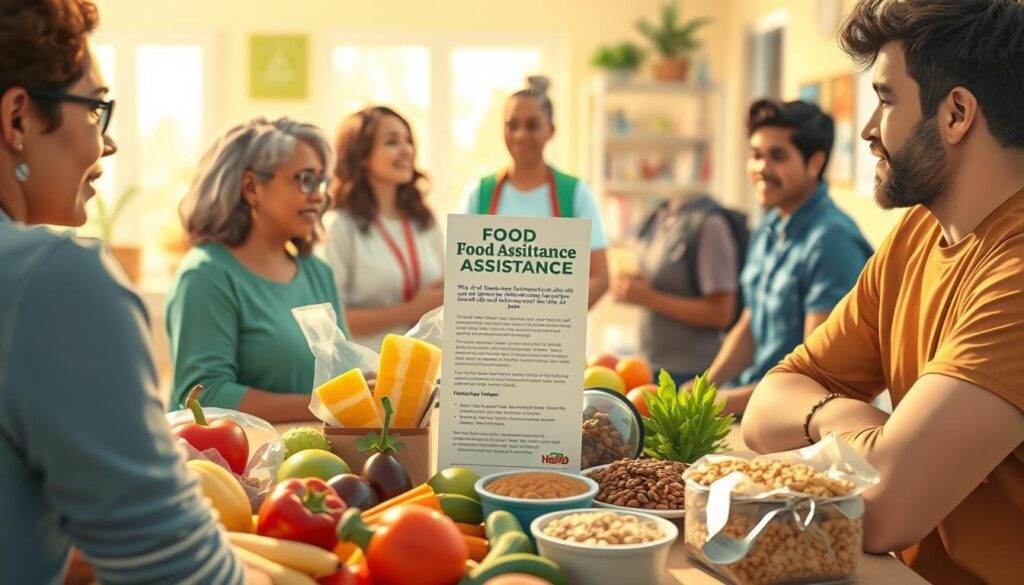
Food assistance benefits help people buy or receive nutritious food through federal, state, and local programs. These programs reduce hunger and support diets for children and adults. They work with partners like food banks and schools to reach people in need.
Definition of Food Assistance
Food assistance means services that provide meals, groceries, or vouchers to eligible households. Delivery methods include EBT cards, paper vouchers, and direct commodity distribution.
Other methods are on-site meal programs and nutrition education. Many people rely on government help during job loss, medical crises, or rising prices.
Types of Food Assistance Programs
Several major programs form the safety net. SNAP, or food stamps, gives monthly electronic benefits for grocery shopping. WIC supports pregnant women, new mothers, infants, and young children with food and nutrition counseling.
TEFAP sends USDA commodity foods to food banks and pantries. School meal programs, like the National School Lunch Program and Breakfast Program, feed children during school days. The Child and Adult Care Food Program funds meals at daycares and adult care centers.
Local emergency providers like soup kitchens and pantries offer quick help when benefits can’t wait. States set eligibility rules and handle applications. Federal funding supports many main programs and benefit adjustments happen sometimes.
Who Is Eligible for Food Assistance?
The rules for food assistance eligibility vary by program and by state. Eligibility depends on income, household size, assets, and specific circumstances like age or disability.
Participation in other public programs can also affect eligibility. Readers should check their state agency for current charts and contact details when preparing an application.

Income Requirements
Most SNAP benefit decisions use two income tests: gross income and net income. Gross monthly income must often be at or below 130% of the federal poverty level.
Net income, after deductions like housing, child care, and medical costs, generally must be at or below 100% of the federal poverty level. States publish income charts that adjust for household size and cost of living.
Asset limits have changed in many places. They were $2,250 for most households and $3,500 for elderly or disabled households. Some states have waived or updated these tests, so applicants should check current rules.
Verification of income is required. States request pay stubs, benefit letters, or self-employment records during applications. Periodic reviews and interviews confirm continuing eligibility for food assistance benefits.
Categorical Eligibility
Categorical eligibility lets some households qualify for SNAP without strict income tests. Households receiving Temporary Assistance for Needy Families (TANF) or similar programs often qualify under this rule.
Elderly (60+) and disabled applicants face special rules. They may use different income calculations or be exempt from certain deductions.
Immigration status affects federal SNAP eligibility. U.S. citizens and certain qualified non-citizens can get SNAP benefits. Some states offer food assistance to other immigrant groups with state funds.
Able-bodied adults without dependents, called ABAWDs, must meet work or training rules to get food stamps over three months in 36. Exemptions include pregnant people, caregivers, disabled persons, and those working required hours.
Documentation for categorical eligibility includes proof of program participation, age, disability status, identity, and residency. State agencies do interviews and checks to confirm household makeup and ongoing qualification for SNAP and other food programs.
How to Apply for Food Assistance
Applying for help with groceries can seem hard. This section explains the steps, documents, timing, and support options. This helps applicants know what to expect when starting a food assistance application.
Application Process Overview
Most people apply through their state agency, like the Department of Health and Human Services or Social Services. You can submit forms online, by mail, in person, or by phone if available.
Steps usually include filling out the form, turning in documents, and doing an interview. The interview is often by phone. After review, the agency sends an approval or denial notice. Approved households get benefits through an EBT card.
Non-expedited SNAP decisions usually arrive within 30 days. Emergency cases get decisions in 48 hours. Local food banks and community groups often help with applications and paperwork.
Required Documentation
Applicants must provide proof of identity, like a driver’s license, state ID, or passport. Proof of residence is needed, such as a lease or recent utility bill.
Social Security numbers for household members help verification. If no numbers are available, agencies accept explanation documents. Proof of income includes pay stubs, employer letters, or benefit statements.
Proof of expenses shows net income. Submit rent or mortgage receipts, utility bills, and child care costs. Some states want asset documents if relevant. For categorical eligibility, provide records of TANF or Supplemental Security Income participation.
Special cases need medical expense records for elderly or disabled claimants. Pregnancy proof is needed for WIC enrollment. School records show eligibility for school meal programs. Keep records of submission dates and copies for appeals or recertification.
If a benefit is denied or reduced, applicants can appeal. Recertification happens regularly. Households must report income or household changes to keep food assistance and SNAP benefits accurate.
| Step | Typical Documents | Timeframe |
|---|---|---|
| Start application | Completed application form | Online/phone/mail options available |
| Verify identity & residence | Driver’s license, state ID, lease, utility bill | Submitted with application |
| Income verification | Pay stubs, benefits letters, tax forms | Needed for food assistance eligibility |
| Expense documentation | Rent, mortgage, utilities, child care receipts | Used to calculate net income |
| Categorical proof | TANF or SSI award letters | Can speed qualification |
| Interview & decision | Eligibility interview notes | Standard decisions within 30 days; expedited SNAP benefits within 48 hours |
| Receive benefits or appeal | Approval/denial notice, appeal forms | Follow agency instructions for next steps |
Understanding SNAP Benefits
SNAP gives monthly food help through Electronic Benefit Transfer cards. These cards work like debit cards at approved stores.
Recipients use EBT benefits at supermarkets, many grocery stores, some farmers markets, and online retailers like Amazon and Walmart. Online buying is allowed in certain states.
SNAP covers most groceries like fruits, vegetables, meat, dairy, bread, cereals, and seeds for home gardening. It does not pay for hot meals, alcohol, tobacco, vitamins, or household supplies.
States send SNAP benefits each month. Retailers then settle transactions with the USDA through their payment processors.
How SNAP Works
To be eligible, households must meet size and income tests. After joining, they get an EBT card that stores their monthly benefit.
At checkout, the cardholder chooses SNAP benefits to pay for allowed items. The process is like using a debit card but limits some product types.
SNAP Benefit Calculation
Benefits depend on household size, gross income, deductions, and USDA’s maximum allotment from the Thrifty Food Plan. The steps: check gross income eligibility, subtract deductions, find net income, then apply the formula.
A simple example shows the math. Start with monthly gross income. Subtract 20% earned income deduction if it applies, child support paid, the standard household deduction, and qualifying shelter or medical costs.
The result is net income. Monthly SNAP benefit equals the maximum allotment minus 30% of net income.
Benefit amounts change with emergency allotments, cost-of-living updates, and federal policy shifts. Some states add their own supplements to the SNAP benefit.
This helps adjust food assistance to fit changing needs and circumstances.
Other Food Assistance Programs
Beyond SNAP, many federal and state programs help households stretch their food budgets. These programs target specific needs like maternal nutrition and emergency food aid.
They work through clinics, food banks, and local partners to complement regular food assistance benefits.
WIC
WIC supports pregnant and postpartum women, infants, and children up to age five who face nutrition risks. It supplies supplemental nutritious foods such as infant formula, milk, cheese, and cereal.
In many places, WIC also provides fruits and vegetables through farmers market programs.
To apply, income usually must be at or below 185% of the federal poverty level. Those on Medicaid, SNAP, or TANF may qualify automatically.
A health professional must confirm a medical or nutritional risk to qualify.
Local WIC clinics, often run by state or county health departments, handle applications. Benefits come by state-specific methods like EBT cards or vouchers.
Participants receive nutrition education, breastfeeding support, and referrals to health services for more help.
TEFAP
TEFAP provides USDA commodity foods to state agencies that distribute them through food banks and soup kitchens. Local groups get food and funds to serve low-income households for free or little cost.
State rules on accessing TEFAP vary; some set income limits, while others serve anyone in need. TEFAP plays a key role in disasters by increasing food supplies when demand rises.
Both WIC and TEFAP strengthen food assistance networks. They fill gaps left by other benefits and improve access to nutritious foods for families in need.
Using Food Assistance Benefits
Understanding how to use food assistance benefits helps households stretch food budgets. It also helps them access healthier food choices.
The following details explain common redemption points. They also cover how EBT works. Plus, the rules that protect benefit holders and retailers.
Where to Redeem Benefits
SNAP-eligible retailers include supermarkets and most grocery stores. Many farmers markets accept benefits and join incentive programs.
These programs include SNAP Healthy Incentives Program and Double Up Food Bucks. They help boost purchases of fruits and vegetables.
Participating online retailers let recipients shop with EBT benefits for approved foods. The USDA posts lists of authorized retailers.
State agencies share local options so recipients can find nearby places to redeem benefits.
Restaurants are usually not eligible, with some exceptions for elderly or disabled clients under Restaurant Meals Programs. Convenience stores lacking authorization and nonparticipating online marketplaces cannot accept benefits.
Understanding EBT Cards
EBT cards are issued by state agencies and loaded monthly with each household’s benefit amount. They operate like debit cards and require a PIN.
These cards only draw from designated benefit balances for allowed food purchases. Recipients can check balances by phone, online portals, or at checkout.
If a card is lost or stolen, report it to the issuing agency immediately. This protects remaining EBT benefits.
Retailers must provide receipts listing items purchased and the remaining balance. SNAP rules restrict certain purchases and limit benefit use for delivery fees.
Delivery fees are allowed only if a retailer permits charging a separate payment method. Trafficking or selling benefits for cash has severe penalties.
These penalties can include disqualification from programs and criminal prosecution. Clear guidelines help prevent fraud and ensure fair access for all.
The Impact of Food Assistance on Families
Food assistance benefits shape daily life for millions of households in the United States. They affect health, budgets, and community markets.
The next parts explore how these programs improve nutrition and bring economic benefits to families and neighborhoods.
Nutritional gains and limits
Research shows SNAP and related programs reduce food insecurity and increase access to calories and essential nutrients.
Children in households using SNAP or WIC tend to grow better and have fewer diet quality gaps when nutrition education is provided.
WIC participation links to better birth outcomes and higher breastfeeding rates. These effects benefit child development and public health.
Programs combining vouchers, counseling, and community outreach show the clearest nutritional improvements.
Barriers remain due to limited fresh produce access in rural areas and urban food deserts. This can lead families to processed foods.
Some participants also lack good nutrition education or cannot find retailers that accept benefits, reducing diet improvements.
Economic effects at home and in the community
SNAP benefits give households more money for rent, utilities, medical care, and transportation. This reduces financial stress.
Families can meet basic needs better without cutting food quality.
Local economies benefit as every dollar of SNAP spending circulates through grocery stores, farmers, and supply chains.
This creates jobs and boosts sales for businesses from Main Street grocers to regional distributors.
Long-term social benefits include lower healthcare costs, better school performance, and stronger workforce participation as food insecurity drops.
Federal reviews find these programs cost-effective with clear returns compared to their costs.
Practical takeaways
- Combine benefits: When SNAP benefits pair with WIC or school meals, families see larger gains in diet and health.
- Target education: Nutrition education improves purchase choices and amplifies nutritional outcomes from benefits.
- Support access: Expanding retailer participation and farmers market EBT acceptance helps convert benefits into healthier food.
Common Myths About Food Assistance
The public talk about food assistance often mixes facts and fiction. Misunderstandings affect opinions on food stamps and SNAP benefits. Clear facts help people decide to apply and understand how these programs work every day.
Debunking Misconceptions
Myth: “Food assistance is only for lazy people.” The application process needs proof of income. Many recipients work, are older adults, disabled, or caregivers.
Able-bodied adults without dependents must meet work rules and time limits to get benefits.
Myth: “Food assistance covers all grocery costs.” SNAP benefits are meant to supplement food expenses. Amounts vary by household size and income.
Many families still struggle with food insecurity. They must stretch benefits throughout the month.
Myth: “All immigrants are eligible.” Only U.S. citizens and some qualified non-citizens get SNAP. Some immigrants cannot access federal programs.
They may qualify for state or emergency help under certain rules.
Myth: “It’s easy to commit fraud.” USDA and states watch transactions and audit EBT card use. Penalties for fraud are strict.
Studies show most recipients use benefits properly. Fraud rates remain low.
Facts vs. Fiction
Research by the U.S. Department of Agriculture shows SNAP lowers food insecurity. It also improves child nutrition and health over time.
Many studies link food assistance to better health and lower healthcare costs.
Enrollment data show a wide range of participants: families with children, seniors, and employed adults. Typical monthly benefits are modest.
Food stamps rarely cover a full month of groceries for most families.
Stigma stops some eligible people from applying. Community outreach and clear facts about eligibility can reduce these barriers.
When communities explain SNAP, more households get the help they need.
Food Assistance during Emergencies
When disaster strikes, FEMA, USDA, state agencies, and nonprofits quickly coordinate to keep food moving to affected communities. They use mobile kitchens, expanded food bank distributions, and TEFAP shipments to help evacuees and those who lose store access. Partners like Feeding America and local food banks deliver relief using logistics hubs and volunteers, while tracking dietary and medical needs.
Agencies aim to preserve dignity and choice by using EBT benefits and vouchers when they can. Electronic options let displaced families buy food from retailers if brick-and-mortar help is limited. Pop-up distribution sites and grocery chain partnerships speed access for families who cannot travel far.
Eligibility rules and documentation are hard to manage post-disaster. Undocumented residents, people with mobility limits, and households in shelters need special outreach. Caseworkers, disaster recovery centers, and community groups assist with registrations and referrals, ensuring food aid reaches vulnerable people quickly.
The Role of Food Aid in Disasters
Food aid stabilizes nutrition and prevents hunger during recovery. Rapid delivery of commodities and prepared meals meets immediate needs while longer-term aid develops. Logistics focus on keeping perishables cold, offering culturally appropriate meals, and coordinating with health services for medical diets.
Local emergency teams work with USDA to release TEFAP stock. They partner with Feeding America to prioritize counties hit hardest. Using EBT benefits in shelters and vouchers eases congestion at distribution points. This layered approach combines federal resources with local knowledge for faster relief.
Temporary Benefits during Crises
States can issue emergency allotments and expand SNAP to meet rising needs in disasters. Disaster SNAP (D-SNAP) gives short-term help to households that lost food or income. These measures help families until income and community services return.
USDA waivers allow flexibility in application timelines, work rules, and reporting deadlines. Simplified enrollment at recovery centers and community groups speeds access. Caseworkers use mobile intake and online forms to approve benefits quickly during crises.
| Response Element | Primary Agencies/Partners | Typical Tools | Benefit for Households |
|---|---|---|---|
| Immediate meal distribution | FEMA, local emergency managers, Salvation Army | Mobile kitchens, meal buses, hot meal points | Quick nourishment for evacuees and responders |
| Commodity releases | USDA, state emergency offices, Feeding America | TEFAP boxes, warehouse staging, trucking | Bulk food for mass distribution and pantries |
| Cash-equivalent access | State SNAP agencies, retailers | EBT benefits expansion, vouchers, emergency allotments | Choice at grocery stores, supports special diets |
| Short-term SNAP aid | State human services, USDA | D-SNAP enrollment, simplified intake, waivers | Temporary benefits during income loss |
| Outreach and case management | Community organizations, United Way, local health departments | Hotlines, recovery centers, multilingual teams | Improved access for seniors, non-English speakers |
Food Assistance and Local Resources
The local food help network includes hotlines, agencies, and groups that connect households to support fast. Readers can use directories and community contacts to find services that fit their needs and schedules.
This section shows practical steps for locating local services. It also shows how community groups expand food assistance access.
Finding Local Food Pantries
Start with Feeding America’s food bank locator, state 2-1-1 hotlines, and local health and human services. These resources help find local food pantries.
Community action agencies often keep lists of meal programs and dates for mobile pantries.
Pantry hours and rules differ by site. Some require registration, while others allow walk-ins. Call ahead to confirm rules and eligibility.
Check if they offer culturally appropriate foods or produce distributions.
Many pantries provide prepared meals and mobile services for rural or underserved areas. Keep a short list of nearby options.
This helps households get groceries quickly when needed.
Community Support Services
Local nonprofits, faith groups, and social service departments work together to offer community support. They connect families to SNAP outreach, application help, and nutrition education.
They also refer families to job training, housing aid, and WIC clinics. Agencies help with recertification and guide applicants to other benefits like Medicaid, TANF, and LIHEAP.
Volunteers and donors play a key role in keeping food assistance going. People who want to help can ask about volunteer shifts, donation drives, or advocacy at a nearby food bank or pantry.
| Resource | What It Offers | How to Access |
|---|---|---|
| Feeding America Food Bank Network | Food distributions, mobile pantries, referral to local pantries | Use the national locator or contact local member banks |
| State 2-1-1 Hotline | Information on meal sites, pantry hours, SNAP outreach | Call 2-1-1 or check state human services listings |
| Community Action Agencies | Groceries, emergency aid, case management, referrals | Visit county offices or agency websites for intake details |
| WIC Clinics | Nutrition counseling, supplemental foods for women and children | Apply through local health departments or clinic sites |
| Faith-Based Pantries | Regular distributions, volunteer-run meal programs | Contact local churches or faith groups for schedules |
Future of Food Assistance Programs
The future of food assistance programs depends on policy decisions, federal funding, and how well systems adapt to new needs.
Experts are considering reforms to expand eligibility and raise benefit levels to match the real cost of healthy food.
They also want to modernize delivery, including broader options for buying food online.
Any changes rely on updates to the Thrifty Food Plan and state actions adjusting asset tests and recertification rules.
Proposed Changes and Improvements
Common proposals aim to make benefits more focused on nutrition and simpler to use.
Policymakers discuss fruit and vegetable incentives, better nutrition education, and support for children and seniors.
They also want to improve how applications are processed and upgrade data systems to reduce delays and increase enrollment.
The Role of Advocacy Groups
Groups like Feeding America, the Food Research & Action Center (FRAC), the Children’s Defense Fund, and the National WIC Association influence the debate.
These groups run outreach campaigns, do research, file lawsuits when access is limited, and lobby Congress for funding.
State anti-hunger coalitions work to make program changes that fit local needs.
Readers can help by contacting officials, joining local groups, participating in USDA or congressional comments, or supporting enrollment drives.
Food assistance has lowered hunger and food insecurity, but future success depends on reforms, budgets, and ongoing advocacy across the U.S.